

Is an AC compressor replacement a wise investment in your home's comfort, or is it just a temporary bandage for a system that's already reached its limit? When your cooling stops during a record-breaking heatwave, the pressure to make a quick, expensive decision can be overwhelming. You're likely facing a mix of technical jargon and high price tags that make it hard to know if you're being treated fairly. We understand that you want a solution that lasts, not just a quick fix that leads to more trouble down the road.
In this guide, we'll provide the clarity you need to handle an AC compressor replacement with confidence. You'll learn how to identify compressor failure and how the 2026 transition to A2L refrigerants affects the long-term value of your current unit. We'll also provide a straightforward framework to help you decide between a part repair and a full system replacement. This ensures you find a path that fits both your budget and your home's cooling needs for years to come.
Key Takeaways
- Learn how the compressor acts as the heart of your HVAC system by circulating refrigerant to maintain a cool, comfortable indoor environment.
- Identify early warning signs of failure, such as "hard starting" or unusual grinding noises, to address issues before they lead to a total loss of cooling.
- Apply the "5,000 Rule" to objectively decide if an AC compressor replacement is a wise repair or if your budget is better spent on a full system upgrade.
- Understand how technical factors like unit tonnage and compressor stages influence the overall cost and efficiency of your cooling solution.
- Discover why professional installation standards, including precise brazing and correct refrigerant levels, are critical for the longevity of your new component.
Understanding the AC Compressor: The Heart of Your Home Cooling System
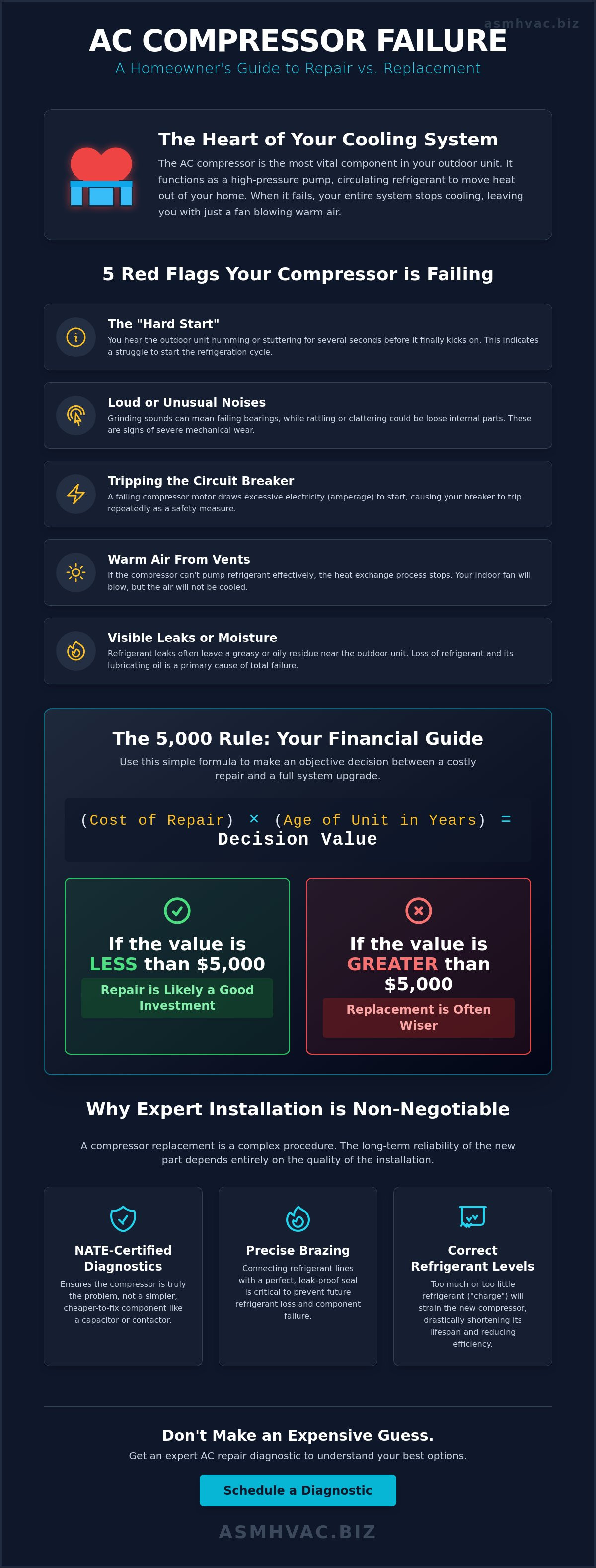
Think of the compressor as the engine of your air conditioner. While many homeowners view the entire outdoor unit as "the AC," that metal cabinet actually houses several distinct components. The compressor is the most vital among them. It functions as a high-pressure pump that circulates refrigerant through the system, acting as the primary force that makes cooling possible. Without this circulation, heat cannot be moved out of your home. This is why an AC compressor replacement is often the most significant repair a homeowner can face. When this part fails, the system loses its ability to transfer heat entirely; you're left with a fan that simply moves warm air around the house.
Because it's a complex mechanical component that operates under extreme pressure, it's the most expensive part to replace. It requires precise electrical connections, hermetically sealed housings, and perfect lubrication to function. If the compressor "seizes" or the motor windings burn out, the heart of your HVAC system has stopped beating. In these cases, your only options are a major repair or a complete system upgrade.
How the Refrigeration Cycle Works
To understand the value of this component, it helps to look at how AC compressors work within the larger cooling cycle. The process begins when the compressor receives cool, low-pressure refrigerant gas from your indoor unit. It then squeezes this gas, which rapidly increases both its pressure and its temperature. This hot gas travels to the outdoor condenser coils, where it releases heat to the outside air and transforms into a high-pressure liquid. The compression stroke in a residential unit is the mechanical action that reduces the volume of the refrigerant vapor, forcing its temperature to rise above the outdoor ambient temperature so heat can be rejected.
Why Compressors Are Vulnerable in Redlands
Living in the Inland Empire presents unique challenges for HVAC equipment. Our frequent heat waves, where temperatures regularly climb into the triple digits, place an immense workload on your system. High ambient temperatures mean the outdoor air is already hot, making it much harder for the condenser to dump heat from your home. This forces the compressor to run longer, more frequent cycles to maintain your comfort. This constant operation increases the mechanical wear on internal valves and motor bearings.
Because the stakes are so high, we always emphasize the importance of NATE-certified diagnostics. Sometimes a system that won't start isn't suffering from a dead compressor; it might just have a failed capacitor or a simple electrical connection issue. A professional assessment ensures you don't commit to an AC compressor replacement unless it's the only viable solution for your home.
5 Red Flags Your AC Compressor Is Failing
Recognizing the early warning signs of a dying compressor can prevent a minor repair from turning into an emergency AC compressor replacement. While some failures happen instantly, most compressors provide clear signals that they're struggling under the load. If you notice any of these five red flags, it's time to have a professional evaluate your system before it stops working entirely during a heatwave.
- The "Hard Start": If you hear your outdoor unit humming or stuttering for several seconds before the fan kicks on, the compressor is struggling to overcome the initial pressure of the refrigeration cycle.
- Loud or Unusual Noises: Grinding sounds often indicate failing internal bearings, while clattering or rattling suggests that the internal mounts or valves have come loose.
- Tripping the Circuit Breaker: A failing compressor often draws excessive amperage as it tries to start. If your AC trips the breaker repeatedly, the motor windings may be shorting out.
- Warm Air from Vents: When the compressor can't pump refrigerant effectively, the heat exchange process fails. The indoor fan will still blow, but the air won't be cool.
- Visible Leaks or Moisture: Refrigerant leaks often leave behind a greasy residue or oil at the base of the condensing unit. This loss of lubricant is a primary cause of total mechanical failure.
If your system exhibits these symptoms, scheduling an expert AC repair diagnostic can help determine if the component is salvageable or if a full replacement is necessary.
Mechanical vs. Electrical Failure
Technicians generally categorize compressor failure into two types: mechanical and electrical. A mechanical seizure, often called a "locked rotor," occurs when internal parts physically jam, preventing the motor from turning. Electrical burnouts are often more severe. When the motor windings fail, they can release acidic byproducts into the refrigerant lines. To check for this, technicians perform an "acid test" on the refrigerant oil. If the test is positive, the entire system must be flushed to prevent the new compressor from being destroyed by contaminated oil.
Symptoms That Mimic Compressor Failure
It's vital to remember that not every "dead" AC unit requires an AC compressor replacement. Several smaller, less expensive components can mimic the symptoms of a failed compressor. A bad start capacitor, for instance, is a common culprit. If the capacitor can't provide the electrical "boost" needed for startup, the compressor will hum and trip the breaker, even if it's perfectly healthy. Similarly, a pitted or burnt contactor can prevent power from reaching the compressor at all. Following official guidance on maintaining your cooling system and investing in a professional diagnostic can save you from replacing an expensive part that still has years of life left.
The Big Question: AC Compressor Replacement vs. Full System Upgrade
Facing an AC compressor replacement is a significant crossroads for any homeowner. Unlike a simple fan motor or capacitor swap, this is a major "heart transplant" for your HVAC system. The process is extremely labor-intensive. A technician must braze new connections, pull a deep vacuum to remove every trace of moisture, and recharge the system with precise levels of refrigerant. Because of the technical skill and time involved, labor costs can often rival the price of the part itself. Understanding How Air Conditioners Work helps illustrate why this specific repair is so complex and why the stakes are so high for the longevity of your equipment.
To make an objective choice, many professionals use the "5,000 Rule." You multiply the age of the unit by the estimated repair cost. If the total exceeds $5,000, a full system replacement is generally the smarter financial move. For example, if a 12-year-old unit needs a repair totaling $700, the result is $8,400; this indicates that your money is better spent on new equipment. You should also verify your warranty status. While some manufacturers offer 10-year part warranties, they rarely cover the cost of labor or the expensive refrigerant needed to get the system running again. If your unit is out of warranty, an AC compressor replacement might only buy you a few more years on a system where other components are also nearing their limit.
The R-22 vs. R-410A Dilemma
If your system was manufactured before 2010, it likely uses R-22 refrigerant, often called Freon. This refrigerant has been phased out, and its cost has become astronomical as supplies dwindle. Even newer systems using R-410A are now facing changes. As of January 1, 2025, the manufacturing of new residential systems using R-410A is banned due to its high global warming potential. This shift means that R-410A will become increasingly expensive to source for repairs. Upgrading to a modern system using A2L refrigerants like R-454B or R-32 is often the only logical path for aging units, as it ensures your system remains serviceable for the next decade.
Efficiency and Long-Term Savings
Modern high-efficiency installations offer a level of performance that older units simply cannot match. The Department of Energy has updated standards to SEER2, requiring a minimum rating of 14.3 in southern states. Upgrading from an old 10 SEER unit to a modern 18 SEER2 system can reduce your annual cooling electricity costs by nearly 50%. In the intense heat of Southern California, these monthly savings add up quickly, often offsetting the initial cost of the new unit over time. To see how these systems perform, you can explore Lennox Central Air Conditioners through specialists like Around the Clock Heating and Air Conditioning. We provide straightforward pricing to help you compare these two paths clearly, ensuring you have all the facts before making a final decision.
What Determines the Cost of Compressor Replacement in Redlands?
Calculating the investment for an AC compressor replacement involves more than just looking up a part number. Several variables specific to your home and your existing HVAC system influence the final price. In Redlands, we see a wide variety of housing types, from historic homes with ground-level units to modern developments where condensing units are often mounted on rooftops. Each scenario requires a different level of labor and equipment to complete the job safely and effectively.
The primary technical factors that dictate the cost include:
- Unit Tonnage: The cooling capacity of your system, measured in tons, directly impacts the size and cost of the compressor. A 4-ton unit requires a much larger, more expensive component than a 2-ton system.
- Compressor Technology: Basic single-stage compressors are the most affordable. However, if your system uses two-stage or variable-capacity technology for better humidity control, the replacement part itself is significantly more complex and costly.
- Refrigerant Requirements: Federal law requires EPA-certified handling for all refrigerants. The cost includes recovering the old gas, disposing of it properly, and recharging the system with new, virgin refrigerant to the manufacturer's exact specifications.
- Unit Accessibility: If a technician needs specialized ladders or safety rigging to access a rooftop unit, the labor time increases. Ground-level units with clear clearance are generally the most straightforward to service.
Because these variables are so specific to each home, we recommend you request a straightforward quote to understand the exact requirements for your specific cooling system.
Labor and Expertise Requirements
An AC compressor replacement is not a "plug-and-play" repair. It requires a high level of technical precision that only a seasoned professional can provide. One of the most critical steps is the "triple evacuation" process. This involves using a vacuum pump and a micron gauge to ensure the system is completely free of non-condensables and moisture before the new refrigerant is added. If the previous motor suffered an electrical burnout, we also must install a "burnout kit." This specialized filtration system prevents residual acid from the failed motor from destroying your brand-new compressor.
Associated Parts That Must Be Replaced
To protect your investment and maintain your warranty, certain secondary parts must be replaced alongside the compressor. We always install a new liquid line filter drier, which acts as a final defense against internal contaminants. We also replace the start capacitor and the contactor. These electrical components are often what caused the original compressor to fail; installing a new motor without updating these parts is a recipe for a repeat failure. At Air Services Mechanical, we include these vital components in our professional replacement quotes to ensure your system is restored to its peak reliability.
Why Expert Installation is Non-Negotiable for Compressors
An AC compressor replacement is one of the few HVAC tasks that allows zero margin for error. Because the compressor operates as a sealed, high-pressure system, any introduction of moisture, air, or debris during the installation process will lead to a premature failure. Professional technicians use a technique called nitrogen purging while brazing copper lines. This prevents oxidation from forming inside the pipes, which would otherwise flake off and clog the small orifices of your cooling system. Without these specialized tools and methods, even a brand-new part can be ruined in just a few weeks of operation.
Beyond the mechanical assembly, the precise volume of refrigerant is critical for optimal heat exchange. Overcharging or undercharging the system by even a few ounces can strain the new motor and significantly increase your energy bills. Furthermore, most manufacturers explicitly state that their parts warranty is only valid if a licensed contractor performs the work. Attempting a DIY fix or hiring an uncertified handyman often voids your protection, leaving you responsible for the cost if the part fails again. For Redlands homeowners facing the peak of summer heat, having access to 24/7 support ensures that your major repair is backed by professional accountability when you need it most. For those seeking comparable expertise in Northern California, christensenair.com provides specialized cooling services for the Roseville community.
The Air Services Mechanical Advantage
With more than 20 years of experience serving the Inland Empire, our team understands the specific demands our climate places on residential cooling equipment. We rely on NATE-certified technicians who approach every AC compressor replacement with methodical precision. Our business is built on a foundation of professional reliability and quiet confidence. We believe in providing straightforward pricing so you know exactly what to expect before the work begins. Unlike many companies in our industry, we do not require long-term service contracts. We prefer to earn your trust through the quality of our workmanship and our honest, no-nonsense approach to home maintenance.
Scheduling Your Diagnostic in Redlands
If your air conditioner is struggling or has stopped cooling entirely, the first step is a thorough diagnostic. When you contact us for an emergency visit, we prioritize getting a seasoned expert to your door to evaluate the system's health. During this initial call, we don't just look at the failed part; we examine the entire refrigeration circuit to find the root cause of the breakdown. This transparency ensures you aren't just replacing a part, but solving the problem that caused the failure in the first place. We are ready to act as your steady guide through these technical decisions. Schedule your expert AC diagnostic with Air Services Mechanical today to restore your home's comfort and peace of mind.
Securing Your Home's Cooling Future
Making a major HVAC decision doesn't have to be a source of stress when you have a clear framework to follow. By recognizing early failure signals and applying the "5,000 Rule" to your repair estimates, you can objectively determine if a part swap or a full system upgrade is the most responsible path forward. It's essential to remember that the quality of the installation is just as critical as the component itself, particularly when facing the intense cooling demands of the Inland Empire.
Air Services Mechanical brings over 20 years of local experience to every diagnostic and repair. Our NATE-certified technicians are fully licensed, bonded, and insured, ensuring that every refrigeration task is handled with technical precision and professional care. We've built our reputation on being a dependable neighbor who values long-term reliability over quick fixes or high-pressure tactics. We're here to act as your steady guide, providing the honest information you need to make the right choice for your family.
Get a Straightforward Quote on AC Compressor Replacement
We're ready to help you restore your peace of mind and maintain a cool, efficient home for years to come.
Frequently Asked Questions
How long does an AC compressor replacement take?
A standard AC compressor replacement typically takes between 4 and 8 hours to complete. This timeframe includes recovering the old refrigerant, removing the failed component, and installing the new part with precise brazing. Our technicians also spend significant time performing a "triple evacuation" to ensure the system is completely free of moisture before recharging it with new refrigerant and testing for proper operation.
Is it worth replacing a compressor on a 10-year-old AC unit?
Replacing a compressor on a system that is 10 years or older is often not the most cost-effective decision. Since the average lifespan of a residential unit is 12 to 15 years, you may find that other components begin to fail shortly after the repair. Additionally, older units use refrigerants like R-410A that are becoming more expensive to source as they're phased out in favor of newer, more efficient A2L alternatives.
Can I replace my own AC compressor?
No, you cannot legally or safely replace an AC compressor as a DIY project. Federal law requires an EPA Section 608 certification to handle and recover refrigerants. The process also requires specialized equipment like vacuum pumps, micron gauges, and oxy-acetylene torches. Attempting this repair yourself will void any manufacturer warranties and could lead to significant system damage or personal injury.
Why did my AC compressor fail in the first place?
Most compressor failures are the result of an underlying issue that wasn't addressed, such as a refrigerant leak or a failed start capacitor. Overheating is another primary cause, often triggered by dirty condenser coils that force the motor to work harder than intended. If a technician doesn't identify and fix this root cause during the AC compressor replacement, the new part is likely to suffer the same fate.
What is the difference between a compressor and a condenser?
The compressor is a specific mechanical pump located inside the outdoor unit, while the condenser refers to the entire outdoor assembly including the coils and fan. You can think of the compressor as the engine that moves refrigerant, whereas the condenser is the heat exchanger that releases heat into the outside air. While people often use the terms interchangeably, the compressor is just one part of the larger condensing unit.
Will a new compressor make my AC more energy efficient?
A new compressor will likely restore your system to its original factory efficiency, but it won't upgrade the unit's overall SEER2 rating. If your goal is to significantly lower your monthly utility bills, a full system replacement is a better path. Modern high-efficiency systems are designed with advanced internal components and refrigerants that provide much better performance than a simple part swap on an aging unit.
Does Air Services Mechanical offer emergency service for compressor failures?
Yes, we provide 24/7 emergency AC repair services to ensure Redlands homeowners aren't left without cooling during dangerous heatwaves. We understand that a major component failure often happens at the most inconvenient times. Our technicians are ready to respond quickly to diagnose the issue and provide a straightforward explanation of your options, whether that involves a repair or a complete system upgrade.
Is the compressor covered under my HVAC manufacturer warranty?
Most manufacturers provide a 5 to 10-year warranty on the compressor part itself, provided the system was registered at the time of installation. However, these warranties almost never cover the cost of labor, shipping, or the new refrigerant required for the repair. It's important to have a professional verify your warranty status before proceeding, as the out-of-pocket costs for labor can still be significant.


