

The system designed for the coldest winter may not suit Southern California. For many homes, a properly sized heat pump is a strong option for the best HVAC for Southern California’s climate because it provides both cooling and heating. The right system still depends on your home’s layout, existing ductwork, and comfort needs.
When warm weather is a regular concern, reliable cooling matters, but it’s also worth considering how you’ll heat your home on cooler days. This guide compares heat pumps, central HVAC, and ductless mini splits, and explains what to consider when choosing a system. You’ll also see why correct sizing and duct condition matter, helping you choose based on your home rather than the system name alone.
Key Takeaways
- A heat pump can provide both cooling and heating, while the right setup depends on your home and comfort needs.
- Consider your home’s layout and existing ductwork when weighing central HVAC against a ductless mini split.
- Proper system sizing matters for comfort, so the best option isn’t determined by equipment type alone.
- Learn when HVAC installation, AC repair, or furnace repair may be the practical next step.
Best HVAC for Southern California climate
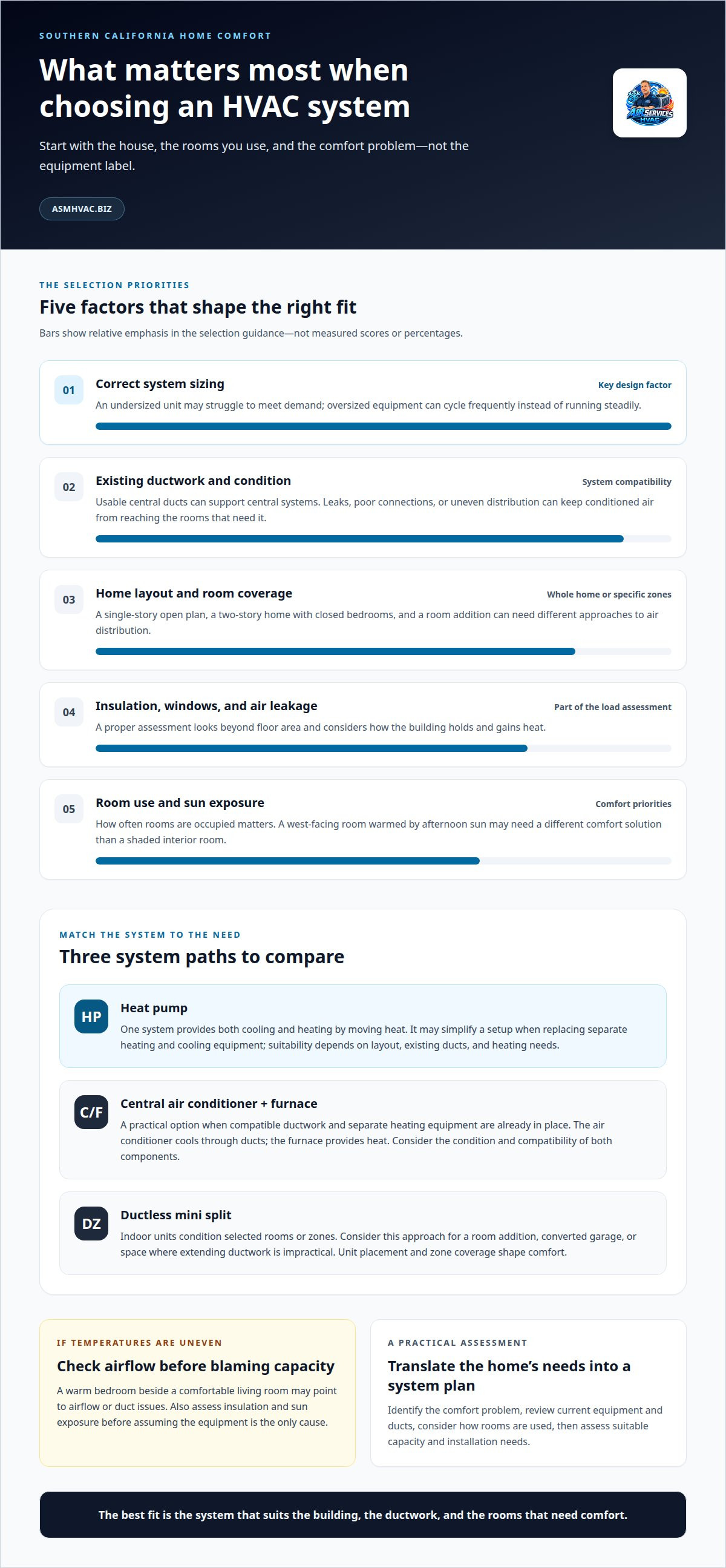
The best HVAC for Southern California’s climate depends on how your home handles both cooling and heating. A heat pump provides both in one system, while central air conditioning paired with a furnace separates those functions. Ductless mini splits offer another option for homes or rooms where extending ductwork is impractical. Start with the home’s needs, not a one-size-fits-all equipment label.
Southern California homes vary in layout, insulation, windows, and sun exposure. A single-story home with open living areas may distribute air differently from a two-story home with closed bedrooms. A west-facing room warmed by afternoon sun may also need a different comfort solution than a shaded interior room. These details affect system design and how evenly temperatures are maintained.
Compare the main system types
A heat pump moves heat rather than generating it in a furnace. In cooling mode, it removes heat from indoors; in heating mode, it moves heat inside. One system can therefore serve both seasons. For a homeowner replacing separate heating and cooling equipment, a heat pump may simplify the setup. Its suitability still depends on the home’s layout, existing ducts, and heating needs.
A central air conditioner paired with a furnace can be practical when a home already has compatible ductwork and separate heating equipment. The air conditioner cools the home through ducts, while the furnace provides heat. This combination may make sense when one part needs replacement and the other remains functional. Consider equipment condition and compatibility, not just the age of one component.
Match the equipment to the house
System sizing is a key part of HVAC selection. An undersized unit may struggle to meet demand, while oversized equipment can cycle frequently instead of running steadily. Choose neither capacity nor efficiency based on floor area alone. A proper assessment considers the home’s layout, insulation, windows, air leakage, and local conditions.
Duct condition matters in central systems. Leaks, poor connections, or uneven duct distribution can prevent conditioned air from reaching the rooms that need it. For example, if a bedroom stays warm while the living room feels comfortable, airflow or duct issues may be the cause, not insufficient equipment capacity. Ductless systems avoid central ducts, but unit placement and zone coverage still shape comfort.
- For whole-home heating and cooling: Compare a heat pump with a central air conditioner and furnace, considering existing equipment and ductwork.
- For a room without ducts: Consider whether a ductless mini split can serve that space without extending the central system.
- For uneven temperatures: Assess airflow, duct condition, insulation, and sun exposure before assuming the equipment is the only cause.
Use a practical selection process
Start by identifying what the system needs to solve. Is your priority cooling the whole house, reliable heating, or conditioning a particular room? Then consider the equipment and ducts already in place. A home with usable central ducts has different options from an addition that has never been connected to them.
Next, consider how your household uses each space. If several rooms are occupied throughout the day, whole-home conditioning may be the priority. If a detached or rarely used room needs separate temperature control, a zoned approach may be more relevant. A professional load assessment can translate these details into suitable capacity and equipment recommendations.
Finally, consider installation needs alongside expected comfort. Replacing a central system may involve existing ducts and equipment connections; adding a ductless unit involves choosing indoor locations and coverage. For Redlands-area homes, the best HVAC decision fits the building, addresses its actual comfort concerns, and provides suitable heating and cooling without unnecessary complexity.
Air Services HVAC
Air Services HVAC can help you make a practical system decision based on your home’s comfort needs. HVAC installation covers selecting and setting up a system suited to the home. For a room without ductwork, ductless mini split systems offer a way to condition that space. If existing equipment isn’t working properly, AC repair or furnace repair may solve the problem without making replacement the first step.
The right next step depends on what your home needs: a new system, targeted room comfort, or service for existing heating or cooling equipment. Air Services HVAC can help with these HVAC needs so your decision reflects the home and its equipment, not just a system type. Contact Air Services HVAC to discuss your home’s HVAC needs.
Make Your Next HVAC Decision With Confidence
Choosing the best HVAC for Southern California’s climate means planning for how your household uses its home, not just reacting to today’s discomfort. Consider which rooms need attention, how your needs may change, and whether an update fits your longer-term plans. Those priorities can make your next decision more focused and practical.
Air Services HVAC can help you consider the options for your home and determine a suitable next step. If you’re ready to discuss your HVAC needs, contact Air Services HVAC. A clear conversation is a straightforward place to begin, and the right plan can make home comfort easier to manage.


