
Could uneven temperatures or stale air point to an airflow problem rather than a system that needs replacing? If employees or customers are uncomfortable, it’s reasonable to ask whether your building’s ventilation needs professional attention and how service might affect daily operations. Commercial ventilation services can help address airflow concerns in the context of how your building is used.
This guide covers signs that a system may need attention, what to gather before an assessment, and how to plan service around business operations. Air Services HVAC is a locally owned HVAC contractor based in Redlands, with more than 20 years of industry experience and NATE- and EPA-certified technicians.
Key Takeaways
- Ventilation needs vary with airflow, occupancy, and how each space is used, so assess the building rather than assuming equipment needs replacement.
- Track where comfort or air quality concerns occur, when they arise, and whether building use or conditions have changed.
- Professional commercial ventilation services start with understanding the building’s concerns and evaluating its existing HVAC equipment.
- Depending on the system and site findings, service may involve repair, installation, or preventative maintenance.
Why commercial ventilation services matter for Inland Empire workplaces
Commercial ventilation manages the movement and replacement of indoor air in a building. Heating and cooling primarily adjust indoor temperature, while ventilation concerns how air moves through a space. Needs can vary with the number of people using an area and the activities taking place there. A busy customer area, for example, may have different airflow demands from a lightly occupied storage area. The Ventilation in commercial buildings overview offers additional background on how building ventilation works.
When airflow doesn’t suit a space or the way it’s used, occupants may notice stale air, uneven comfort, or lingering odors. Changing the thermostat may help with temperature but won’t necessarily address a separate airflow concern. Note what people are experiencing and where, rather than treating every complaint as a temperature problem.
What ventilation concerns can affect a commercial building?
Stale air, uneven airflow, lingering odors, and excess moisture are examples of concerns that may warrant a closer look. Record whether an issue affects one room or several, whether it appears at particular operating times, and whether it began after a change in occupancy, equipment, or building use. This detail helps focus an assessment on the affected spaces and conditions.
These signs don’t point to one cause on their own. Odors may have more than one source, while uneven comfort could relate to airflow, HVAC equipment, or how a space is used. A professional evaluation can help identify what’s happening before deciding whether repair, installation, or preventative maintenance is appropriate.
For businesses in Redlands and across the Inland Empire, commercial ventilation services are part of building-specific commercial HVAC support. Air Services Mechanical provides commercial HVAC services, including repair, installation, and preventative maintenance. Its NATE- and EPA-certified technicians bring more than 20 years of HVAC experience to local commercial work. An assessment starts with the conditions in your building, not an assumption that equipment must be replaced.
How to assess commercial ventilation needs in a Redlands building
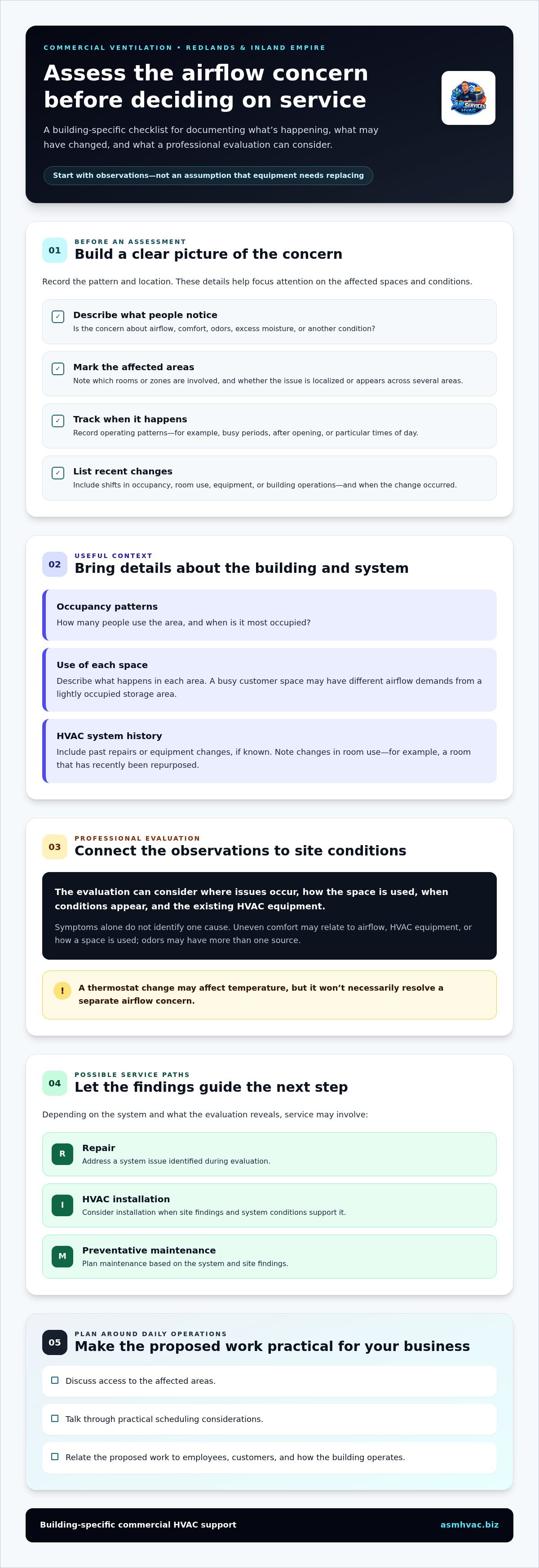
A useful assessment starts with observations, not a remote diagnosis or an assumption that equipment needs replacing. The pattern of a concern can help a professional decide what to examine. Before arranging commercial ventilation services, gather details about the space and its day-to-day use.
- Describe the concern. Note whether it involves airflow, comfort, odors, or another condition.
- Mark affected areas. Record which rooms or zones are involved and whether the issue is widespread or localized.
- Track operating patterns. Note when the concern occurs, such as during busy periods, after opening, or at particular times of day.
- List recent changes. Include shifts in occupancy, room use, equipment, or building operations.
What information should a business gather before an assessment?
Bring notes on occupancy patterns, how each area is used, and relevant HVAC system history, including past repairs or changes if known. For example, if a concern is limited to a room that has recently been repurposed, note what changed and when. The EPA guidance on indoor air quality also provides background on factors that can affect indoor air quality.
During an evaluation, occupancy, building use, and existing HVAC equipment help shape what is examined and which service may fit. Conditions vary by site, so proposed work should reflect the system’s actual condition and applicable requirements rather than a symptom alone. Businesses reviewing broader needs can also explore commercial HVAC services in Ontario, CA.
Air Services Mechanical provides commercial HVAC support for Redlands and Inland Empire businesses. Clear observations help focus the service discussion. Learn more about commercial HVAC support for building-specific needs.
Commercial ventilation service in the Inland Empire: what happens next
After you describe the building’s concerns, a professional evaluation can consider where issues occur, how the space is used, and when the conditions appear. The HVAC team can then assess the existing system and site conditions before identifying appropriate service. This keeps recommendations tied to the building rather than assuming that a particular repair or replacement is needed from the outset.
Findings guide the next step. Depending on the system and what the evaluation reveals, service may involve repair, HVAC installation, or preventative maintenance. Discuss the proposed work in relation to business operations, including access to affected areas and practical scheduling considerations. Understanding the work involved makes it easier to plan around employees and customers.
Choosing a local commercial HVAC service partner
For Redlands and Inland Empire businesses, recommendations should account for the specific building and how it operates. Air Services Mechanical is a locally owned HVAC contractor serving the Inland Empire and San Bernardino communities, with over 20 years of industry experience. The company is licensed, bonded, and insured, and its technicians are NATE-certified and EPA-certified.
A clear service process starts by discussing the concern, evaluating the building’s HVAC conditions, explaining relevant findings, and identifying suitable service. This gives you a practical basis for deciding how to proceed without treating every ventilation concern as a reason to replace equipment. Contact Air Services Mechanical to discuss commercial ventilation services for your building.
Take the next step toward a better-informed building plan
Airflow concerns don’t have to lead straight to an equipment replacement decision. A focused assessment can help set a practical direction for service while keeping employees, customers, and daily operations in view. Commercial ventilation services should start with understanding the site and choosing next steps that fit its conditions.
Air Services Mechanical is based in Redlands and serves Inland Empire communities. The licensed, bonded, and insured contractor brings over 20 years of HVAC industry experience, with NATE-certified and EPA-certified technicians. For local commercial HVAC support, contact Air Services Mechanical to discuss your building’s needs.
Start with a clear account of what you’ve noticed, where it occurs, and how it affects your workplace. Contact Air Services Mechanical to discuss commercial ventilation services in Redlands and the Inland Empire.
Frequently Asked Questions
What does commercial ventilation service include?
Commercial ventilation service can involve evaluating airflow concerns and determining whether HVAC repair, installation, or preventative maintenance is appropriate. The work depends on the system and building conditions, rather than following the same checklist for every property. For example, service for an office with a recurring issue may differ from work for a space whose use has changed. Commercial ventilation services should be guided by site findings.
How can I tell if my commercial building needs ventilation service?
Consider an evaluation if occupants keep raising similar comfort or air concerns, especially if adjusting the thermostat hasn’t addressed them. Notice whether the issue appears during a particular shift, after the building fills, or in a specific zone. A recurring pattern can help distinguish an ongoing building concern from a brief, isolated change, but it can’t identify the cause on its own.
How often should commercial ventilation systems be inspected?
There isn’t one inspection interval that fits every commercial system. Frequency can depend on equipment, building use, manufacturer guidance, and applicable requirements. Cal/OSHA Article 107 requires at least annual testing for mechanical ventilation systems used to prevent harmful exposure, with test records kept for at least five years. That specific requirement doesn’t automatically set the inspection schedule for every building in Redlands.
Does commercial ventilation replace heating and air conditioning?
No. Ventilation manages air movement and replacement, while heating and air conditioning control indoor temperature. A building may need both functions to support its intended use. For instance, adjusting cooling can change how a room feels without addressing a separate ventilation concern. Commercial HVAC professionals can assess how ventilation relates to existing heating and cooling equipment without treating the systems as interchangeable.


