

The capacitor itself is only part of the replacement cost. The cost to replace a capacitor in an AC unit depends on the part required, labor, and any service-call charges, so a DIY repair and professional service can come to different totals. The part price alone doesn’t show what a complete replacement will involve.
It’s reasonable to compare those options, especially when an air conditioner stops working unexpectedly. But this repair also involves electrical components that can retain a dangerous charge after power is off, so safety matters alongside cost. This guide explains what affects DIY and professional expenses, what to consider before attempting the work, and how capacitor lifespan and routine maintenance fit into the decision. You’ll get a clearer basis for judging whether a replacement is a manageable task or one best handled as part of an AC repair.
Key Takeaways
- Separate the capacitor’s part cost from labor and service-call charges to understand what shapes the total.
- Compare DIY and professional replacement with safety in mind: capacitors can retain a dangerous electrical charge even after power is off.
- Learn how heat, frequent system cycling, and routine maintenance can affect a capacitor’s lifespan.
- Recognize when AC symptoms may call for repair rather than a do-it-yourself replacement.
How Much Does an AC Capacitor Cost?
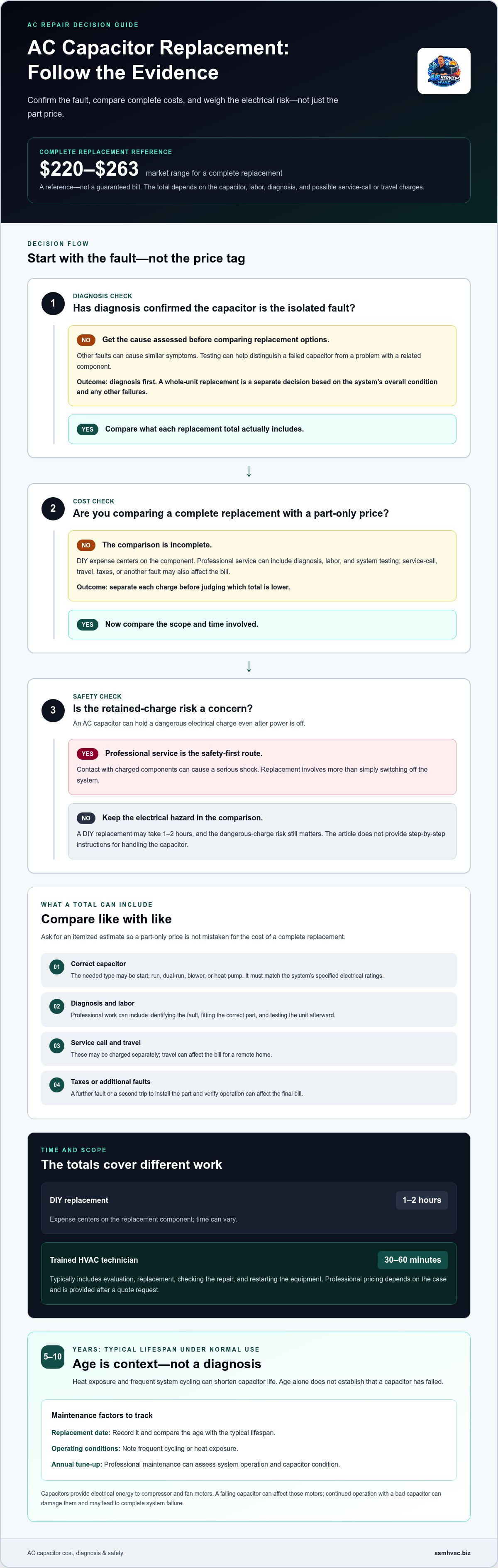
On the market, AC capacitor replacement typically costs between $220 and $263. That range describes a complete replacement, not just the part. The cost to replace capacitor in AC unit depends on the capacitor type, technician labor, and any service-call or travel charges. Treat the market range as a reference, not a guaranteed bill.
The part is only one part of the breakdown. A start, run, dual-run, blower, or heat-pump capacitor may be needed, depending on the equipment. The replacement must match the system’s specified electrical ratings. Labor covers diagnosis, fitting the correct part, and testing the unit afterward. A service call may be charged separately, so distinguish it from repair labor when reviewing an estimate. Travel can also affect the bill for a remote home.
Ask for an itemized estimate showing the part, labor, service call, travel, and taxes. This helps clarify what drives the cost to replace capacitor in AC unit rather than comparing a part-only price with a full repair. An incorrect capacitor can prevent proper operation, so the lowest-priced part isn’t necessarily the right match.
What safety risks are involved? An AC capacitor can retain a dangerous electrical charge after the system is switched off. Contact with charged components can cause a serious shock, so replacement involves more than turning off the power.
Does insurance or an HVAC warranty cover replacement? Homeowners insurance and HVAC warranties have different terms. Coverage depends on the policy or warranty’s covered causes, exclusions, and conditions. For homeowners considering broader property safeguards beyond routine home maintenance and warranties, estate planning specialists like Aiker Wills and Trusts offer legal tools such as property trusts to protect family assets over the long term.
Typical DIY and professional replacement costs
DIY and professional totals differ mainly in what they include. A DIY expense centers on the replacement component, while professional service adds diagnosis, labor, and system testing. Professional pricing depends on the case and is provided after a quote request. The capacitor type, diagnostic findings, labor, and any additional fault affect the estimate.
Time is another practical comparison. A DIY replacement may take 1-2 hours, while a trained HVAC technician can typically complete replacement and testing in 30-60 minutes. That professional time includes more than fitting a part: the technician evaluates the system, checks the repair, and restarts the equipment.
Testing helps distinguish a failed capacitor from another fault that causes similar symptoms. A professional can assess the capacitor and related components, then determine whether replacement addresses the problem. If a second trip is needed to install the part and verify operation, that can also affect the final bill. These steps explain why a part-only DIY estimate and a complete service estimate aren’t direct comparisons.
Is it cheaper to repair or replace an AC unit with a failed capacitor? If diagnosis identifies the capacitor as the isolated fault, replacing that component is the targeted repair. Replacing the whole unit is a separate decision based on the system’s overall condition and any other failures, not the capacitor alone—though homeowners facing recurring equipment failures may look into options like air conditioning installation Los Angeles to start fresh.
For a useful comparison, separate diagnosis, component replacement, and any additional repair in the estimate. A professional AC diagnosis and testing can clarify whether the capacitor is the only issue before you decide on the next step.
Capacitor lifespan and preventive maintenance
An AC capacitor generally lasts 5 to 10 years under normal use. Heat exposure and frequent cycling can shorten its lifespan. Treat that range as a useful reference, not a diagnosis. Record the replacement date, then consider the capacitor’s age alongside how the system operates. Age alone doesn’t establish that a capacitor has failed.
Annual professional tune-ups are recommended to help prolong capacitor life. A technician can assess system operation and the capacitor’s condition during scheduled maintenance. This matters because capacitors provide electrical energy to compressor and fan motors. A failing capacitor can affect those motors, while continued operation with a bad capacitor can damage them and may lead to complete system failure.
Use maintenance to keep track of condition and changes over time:
- Record the capacitor’s installation or replacement date so you can compare its age with the typical 5-to-10-year lifespan.
- Note frequent system cycling or heat exposure, both of which can contribute to a shorter lifespan.
- During an annual tune-up, have the system’s operation and capacitor condition assessed rather than replacing the part based on age alone.
A capacitor’s lifespan is only one part of system upkeep. If your AC is due for a tune-up, schedule preventative maintenance to help monitor its condition and operation.
Air Services HVAC: AC repair
Air Services HVAC provides AC repair when a capacitor fails or the system shows related operating problems. A technician can assess whether the capacitor is the fault or whether another component needs attention. That diagnosis helps determine whether the repair can focus on the capacitor or whether the AC has a broader issue.
If the system continues to struggle after a capacitor replacement, further AC repair can help identify the cause. For older equipment with wider problems, HVAC installation may be a separate consideration. The right path depends on the system’s condition, not the capacitor alone.
For help assessing an AC problem and its repair needs in Redlands, contact Air Services HVAC.
Choose a Clear Next Step for Your AC
Consider the cost of replacing a capacitor in an AC unit as one part of the decision, not the only one. If the system still struggles after repair, assess the equipment’s wider condition before deciding what to do next. A focused diagnosis can help distinguish a single-component issue from a problem that needs broader attention.
Air Services HVAC offers AC repair, furnace repair, and ductless mini split systems. Whether your immediate concern is an AC that won’t run properly or a different home comfort need, start with the issue you’re experiencing and the help you need.
Contact Air Services HVAC for AC help and take a practical next step toward restoring your home’s comfort.
Frequently Asked Questions
How do I know for sure if my AC capacitor is bad?
Symptoms can suggest a bad capacitor, but testing is needed to identify the fault. A humming outdoor unit or a fan that does not start may point to trouble, though other system problems can cause similar behavior. In Redlands, avoid handling the capacitor yourself: it can hold a dangerous charge even after power is off.
How long do AC capacitors typically last?
AC capacitors generally last 5 to 10 years under normal use. Heat exposure and frequent system cycling can shorten that lifespan, so the calendar alone won’t tell you whether replacement is needed. Keep the installation date with your AC maintenance records, and use changes in system operation as a reason to arrange an assessment rather than replacing a part solely because it has aged.
What is an AC capacitor and why is it important?
An AC capacitor stores electrical energy and supplies it to the compressor and fan motors to help them start. Without the right electrical support, those motors may not operate as intended, affecting the cooling system. Capacitors serve different roles, including starting and running components, so identifying the correct type matters when diagnosing a fault or selecting a replacement.
How much does it cost to replace an AC capacitor in the United States?
Across the United States, the market range for AC capacitor replacement is typically $220 to $263. This figure represents replacement overall, not simply the price of a component. The final bill can reflect diagnosis, labor, the capacitor type, and service-call or travel charges. For Redlands homeowners, use the range as a market reference, not a local quote.
What is the average AC capacitor replacement cost including parts and labor?
The market median is about $250, within the typical $220 to $263 replacement range. That central figure includes the parts-and-labor context, but an individual repair may differ based on the required capacitor and work involved. Comparing a complete replacement estimate with a part-only price can be misleading, since the latter excludes diagnosis, installation, and system testing.


