
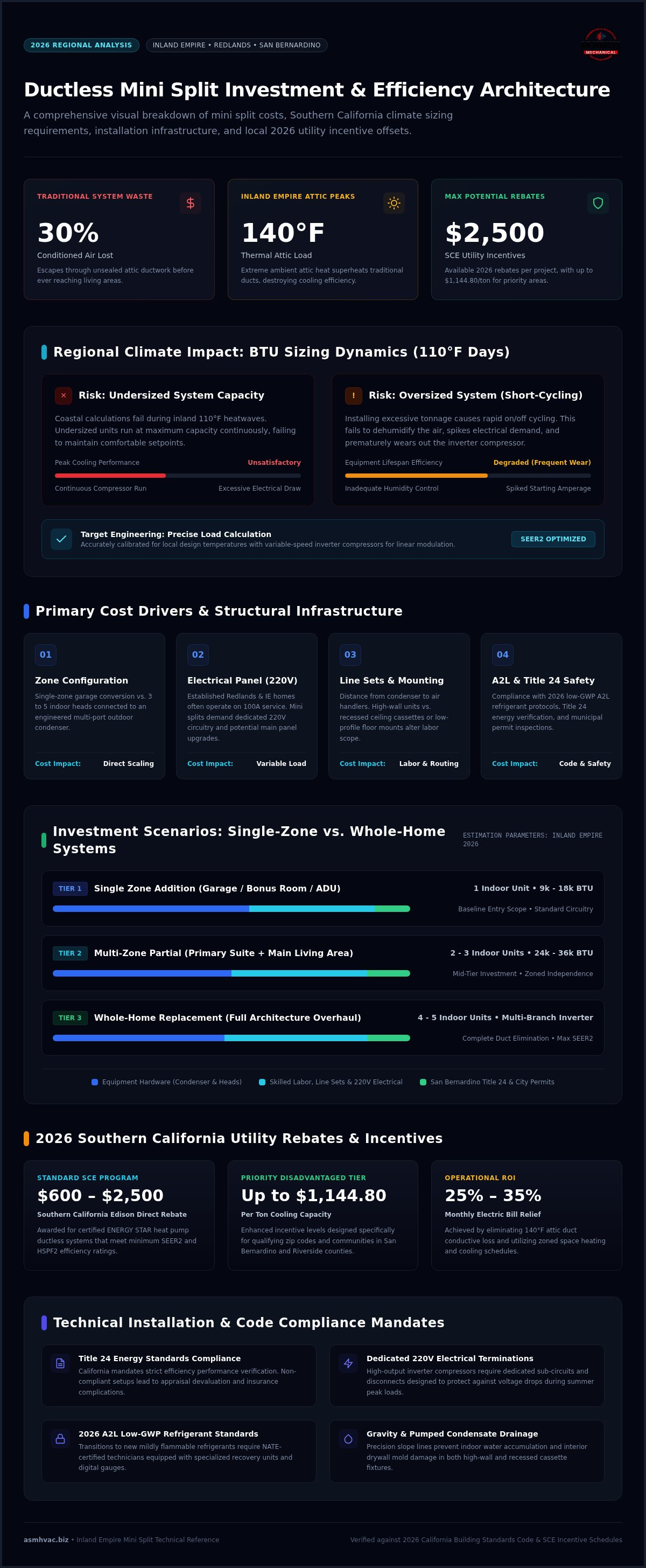
Did you know that up to 30% of your conditioned air is lost through leaky ducts before it ever reaches your living room? In the Inland Empire, where attic temperatures often hit 140°F, that's a direct hit to your monthly budget. You're likely seeking a more efficient way to cool your home, but finding a clear ductless mini split cost Inland Empire estimate often feels like a moving target. Between evolving SEER2 ratings and new A2L refrigerant safety standards, it's easy to feel overwhelmed by the technical details.
This guide provides the straightforward clarity you need. We'll break down the real-world factors that influence your investment, from electrical panel requirements in older Redlands homes to the specific Southern California Edison rebates available in 2026. You'll learn to identify hidden installation variables and maximize local incentives to ensure home comfort without unnecessary financial surprises.
Key Takeaways
- Understand how the Inland Empire’s extreme heat affects BTU sizing and system capacity to ensure reliable cooling during peak summer months.
- Evaluate how the number of indoor zones and electrical requirements for local homes influence the total ductless mini split cost Inland Empire residents will encounter.
- Discover how NATE-certified installation and Title 24 compliance protect your investment and ensure your system meets strict 2026 efficiency standards.
- Identify specific 2026 Southern California Edison (SCE) rebates and utility incentives that help lower the upfront cost of high-efficiency heat pump technology.
Key Factors Influencing Ductless Mini Split Costs in the Inland Empire
Estimating a ductless mini split cost Inland Empire project requires looking beyond the sticker price of the equipment. Several variables specific to our local geography and home construction dictate the final investment. For instance, the number of indoor "zones" or air handlers directly scales the price; cooling a single sunroom is far different than a whole-home solution. High SEER2 efficiency ratings also play a role. While these units carry a higher initial equipment price, they provide significant relief from monthly SCE bills by utilizing advanced heat pump heating and cooling principles to move thermal energy with minimal electricity.
To better understand how these variables affect your budget, watch this helpful video:
Regional Climate Impacts on Unit Sizing
A 110-degree afternoon in Redlands puts immense pressure on your HVAC system. Coastal BTU calculations simply don't work here; our extreme heat is a primary driver of the final ductless mini split cost Inland Empire homeowners face. If a unit is undersized, it won't keep up during a July heatwave. Conversely, an oversized unit leads to short-cycling. This frequent on-and-off switching increases wear on the compressor and spikes your energy bills, defeating the purpose of a high-efficiency system.
Physical installation complexity also influences the total budget. Our technicians evaluate several structural factors during the planning phase:
- Line Set Length: The distance between the outdoor compressor and indoor heads affects labor and material costs.
- Mounting Requirements: High-wall mounts are standard, but specialized floor or ceiling cassettes may require additional structural work.
- Drainage Solutions: Proper condensate management is vital to prevent moisture damage inside your home.
While these technical requirements are specific to the Inland Empire's climate, the need for professional precision is universal. If you are looking for similar high-quality residential cooling services in other areas, you can discover Essex Home Air Conditioning for expert installation guidance.
Installation and Equipment Pricing Breakdown for Southern California
Calculating the total ductless mini split cost Inland Empire residents will pay involves balancing high-performance hardware with skilled labor. Equipment costs vary significantly between a single-zone unit for a garage conversion and a multi-zone outdoor compressor designed for an entire house. While the hardware represents a fixed portion of the budget, the technical expertise required for a reliable setup is equally vital. NATE-certified technicians handle critical tasks like precise refrigerant charging and secure electrical terminations to ensure long-term performance.
Infrastructure often dictates a large part of the installation budget, especially in established neighborhoods with older homes. Most systems require a dedicated 220V circuit. If your existing electrical panel is at capacity, a service upgrade might be necessary to support the new load safely. Choosing ENERGY STAR certified ductless systems helps offset these initial costs over time through lower operating expenses, but the installation must be flawless to achieve those rated savings. For an accurate look at your property's requirements, you can request a professional evaluation from our local team.
The Value of Professional Licensing and Permits
Filing for permits with San Bernardino County or local city municipalities is a non-negotiable step for any reputable project. These permits and subsequent inspections verify that your system meets California’s strict Title 24 energy standards and safety codes. Skipping this step can lead to complications during home appraisals or insurance claims. You can explore our detailed guide on ductless mini split installation Redlands to better understand the localized steps involved in a compliant, professional setup.
Offsetting Costs with Local Rebates and Long-Term Efficiency
Navigating the total ductless mini split cost Inland Empire homeowners face is easier when you account for current utility incentives. In 2026, Southern California Edison (SCE) offers programs that range from $600 to $2,500 for qualifying high-efficiency heat pumps. Residents in designated disadvantaged communities within San Bernardino and Riverside counties may qualify for higher tiers, potentially reaching $1,144.80 per ton. For the most current state-level guidance, the California Energy Commission Building and Home Energy Resource Hub provides a comprehensive look at building decarbonization efforts and regional funding.
While the federal 25C tax credit expired at the end of 2025, the monthly operational savings of ductless technology remains a powerful financial driver. These systems eliminate the 30% energy loss common in leaky attic ducts and reduce power draw by 25% to 40% compared to standard central air units. To keep these savings consistent, regular preventative maintenance is essential. Simple steps like cleaning filters and checking refrigerant levels prevent the efficiency drops that lead to expensive mid-summer emergency calls. This proactive approach ensures your system handles the 105-degree IE heat without a spike in utility costs.
Financing Options for Inland Empire Homeowners
Many families choose to spread out their energy efficient HVAC installation costs through flexible financing plans. We recommend evaluating "zero-down" promotional offers carefully against traditional low-interest HVAC loans. While zero-down plans offer immediate relief, traditional financing sometimes provides better long-term terms for those prioritizing total project equity. Our team helps you weigh these options to find a path that protects your home comfort and your budget simultaneously.
Securing Efficient Comfort for Your Inland Empire Home
Securing a precise estimate for your ductless mini split cost Inland Empire project depends on aligning your home's layout with the demands of our local climate. By prioritizing correct BTU sizing and high SEER2 ratings, you ensure your system handles 110-degree days efficiently. Leveraging 2026 SCE rebates further reduces your initial investment, making high-efficiency cooling more accessible for your family.
Air Services Mechanical brings 20+ years of Inland Empire expertise to every project. Our NATE-certified technicians are fully licensed, bonded, and insured in California, providing the peace of mind that comes from professional standards. We prioritize straightforward results and honest guidance. Contact Air Services Mechanical for a straightforward quote on your ductless mini split today. We're ready to help you achieve lasting comfort in your home.
Frequently Asked Questions
How much does a single-zone mini split cost to install in the Inland Empire?
The total ductless mini split cost Inland Empire residents pay for a single-zone system depends on the unit's capacity and the complexity of the electrical run. Factors like wall-mounting height and the distance to the outdoor condenser influence labor requirements. We provide straightforward, transparent pricing based on a physical assessment of your Redlands home to ensure the equipment matches your specific cooling needs. For homeowners in other regions, such as South Carolina, MT Pleasant Heating & Air Conditioning offers similar professional evaluations to ensure HVAC systems are perfectly sized for local climate demands.
Are there specific rebates for ductless mini splits in San Bernardino County?
Yes, homeowners in San Bernardino County can access several utility-backed incentives to offset the ductless mini split cost Inland Empire families face in 2026. Southern California Edison (SCE) provides rebates for high-efficiency heat pumps that range from several hundred to over two thousand dollars. Residents in designated disadvantaged communities may also qualify for higher incentive tiers based on the system's cooling tonnage.
Does a mini split use more electricity than central air in Southern California?
Ductless systems generally use significantly less electricity than traditional central air units in the Inland Empire. Because they eliminate energy losses associated with leaky attic ductwork, they operate with much higher efficiency. These systems also use inverter technology to adjust cooling output precisely, which prevents the heavy power spikes common when central AC compressors cycle on and off during a Redlands heatwave.
How long does a typical ductless installation take in Redlands?
A standard single-zone installation in Redlands typically takes one business day to complete. More complex multi-zone systems that require extensive electrical work or multiple indoor air handlers may extend the timeline to two or three days. Our NATE-certified technicians focus on a methodical, thorough process to ensure your system meets all local permitting requirements and manufacturer specifications without any unnecessary delays.


