
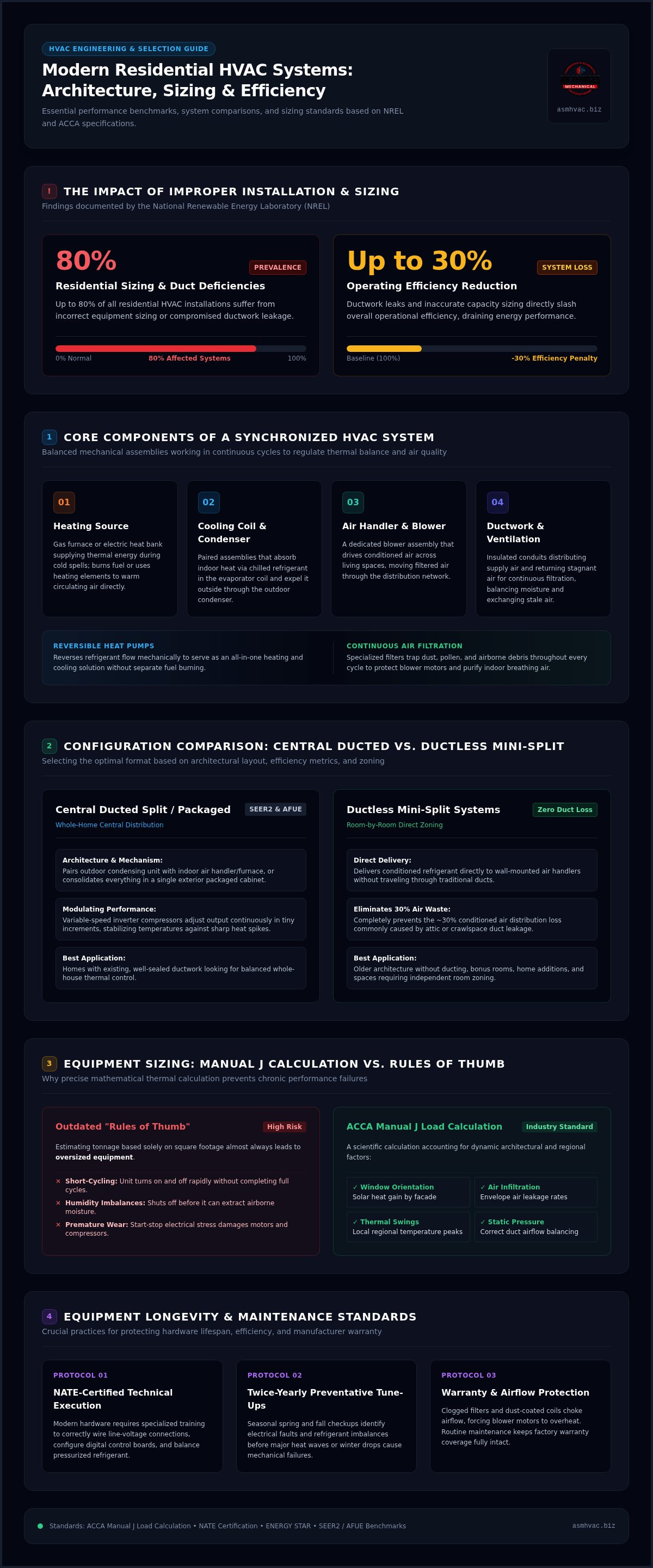
According to the National Renewable Energy Laboratory, up to 80% of residential HVAC systems suffer from improper sizing or duct leakage, cutting operating efficiency by as much as 30%. Sizing a system isn't as simple as picking a large unit with a recognizable brand name. Sorting through technical metrics like SEER2 and AFUE while choosing between central ducted platforms and ductless heat pumps can quickly feel overwhelming.
You shouldn't need an engineering degree to make an informed investment in your home's comfort. This guide clarifies how modern heating, ventilation, and cooling equipment operates so you can select the ideal configuration without paying for costly installation errors. We'll compare ducted versus ductless systems, demystify today's efficiency ratings, and show you how to partner with vetted, certified technicians with complete confidence.
Key Takeaways
- Understand how heating units, cooling coils, and air handlers work in tandem to regulate indoor comfort and air circulation.
- Compare central ducted setups with ductless mini splits to determine which modern HVAC configuration best matches your home layout and efficiency goals.
- Learn why precise Manual J load calculations protect against short-cycling, indoor humidity imbalances, and premature equipment wear.
- Discover how twice-yearly preventative tune-ups safeguard long-term system performance and keep manufacturer warranty coverage intact.
What Is an HVAC System and How Do Its Components Function?
An HVAC system is a synchronized network engineered to regulate indoor temperature, humidity, and airflow throughout your home. Rather than operating as isolated appliances, modern heating, ventilation, and air conditioning systems rely on balanced mechanical cycles to sustain indoor comfort across shifting seasons. A standard residential installation integrates several core assemblies:
- Heating source: A gas furnace or electric heat bank that supplies thermal energy during colder spells.
- Cooling coil and condenser: Paired assemblies that extract heat from indoor air and release it outdoors.
- Air handler: A blower assembly that drives conditioned air across your living spaces.
- Ductwork: Insulated conduits that distribute supply air and return stagnant air for continuous filtration.
Mechanical ventilation works continuously within this loop to exchange stale indoor air with filtered outdoor air, preventing excess humidity buildup and particulate stagnation. While residential setups focus on balanced home airflow, commercial facilities often partner with dedicated HVACR specialists like Abbott Mechanical Services LLC to manage complex ventilation, rooftop units, and chiller systems.
The Interconnected Cycle of Heating, Cooling, and Air Filtration
Air conditioning doesn't generate cold air; it absorbs indoor heat through chilled refrigerant running through an evaporator coil and expels it outside. Furnaces, conversely, burn fuel within a heat exchanger to warm circulating air directly. Reversible heat pumps streamline this process by reversing refrigerant flow, serving as an efficient all-in-one heating and cooling solution. Throughout every cycle, specialized air filters trap dust, pollen, and airborne debris, which protects sensitive blower motor components while keeping household air clean.
Comparing Modern HVAC Configurations: Central Ducted vs. Ductless Systems
Selecting the right setup comes down to your home's layout and regional climate demands. Split central systems pair an outdoor condensing unit with an indoor air handler or furnace, making them ideal for properties with solid duct networks. Packaged units combine all components into a single exterior cabinet to conserve interior space. Efficiency is benchmarked by SEER2 for cooling and AFUE for gas heating efficiency. Following ENERGY STAR heating and cooling recommendations ensures your equipment meets regional benchmarks without struggling during Inland Empire summer heat. For homes with bonus rooms or older architecture, reviewing ductless mini split installation Redlands options offers flexible, room-by-room zoning.
Evaluating System Efficiency, Zoned Control, and Structural Layout
Ductless mini splits deliver conditioned refrigerant directly to wall-mounted air handlers, eliminating the ductwork leaks that can waste up to thirty percent of conditioned air distribution. If your home already possesses well-sealed, balanced ductwork, scheduling an energy efficient HVAC installation with a variable-speed inverter compressor provides seamless comfort. These modulating compressors adjust output continuously in tiny increments, stabilizing temperatures against sharp afternoon heat spikes and brisk desert nights. If you aren't certain which design fits your floor plan, consulting an experienced technician ensures you choose the right balance of efficiency and comfort.
Key Selection Criteria: Sizing, Installation Quality, and Professional Maintenance
Brand reputation means little if the equipment is improperly sized or carelessly installed. Outdated rules of thumb based solely on square footage frequently result in oversized units. These systems short-cycle, turning on and off rapidly without running long enough to balance indoor humidity. Accurate ACCA Manual J load calculations account for window orientation, air infiltration, and local thermal swings to prevent premature mechanical wear. Modern hvac hardware also requires specialized technical training to manage line-voltage wiring, digital control boards, and pressurized refrigerant lines. Partnering with licensed contractors who employ NATE-certified technicians ensures proper static pressure and reliable operation. In addition, scheduling professional preventative HVAC maintenance services twice a year keeps efficiency high and preserves manufacturer warranty protections.
Protecting Equipment Lifespan Through Expert Sizing and Seasonal Care
Consistent upkeep directly impacts long-term mechanical reliability. Restricted air filters and dust-coated coils choke system airflow, forcing blower motors and compressors to run hot until they suffer premature mechanical breakdown. Catching minor electrical faults or refrigerant imbalances early prevents sudden failures and spares you from urgent furnace repair San Bernardino calls during freezing desert nights. Standard seasonal tune-ups should always include:
- Measuring static pressure and checking duct connections for unrestricted airflow.
- Testing safety limit switches, capacitors, and electrical contactors.
- Cleaning condensate drain lines and inspecting heat exchangers for cracks.
These methodical evaluations ensure your hvac setup operates safely and efficiently through every extreme season.
Take Control of Your Home Comfort and Efficiency
Selecting the right hvac system comes down to matching equipment design to your home's unique layout, rather than relying on generic rules of thumb. Whether you invest in a central ducted heat pump or flexible ductless mini splits, verified sizing calculations and quality installation workmanship protect your equipment from premature strain while keeping monthly energy costs under control.
With over two decades of local mechanical contracting experience throughout Redlands and the Inland Empire, Air Services Mechanical is here to help. Our team features NATE- and EPA-certified field technicians who provide reliable 24/7 emergency response with no mandatory long-term service contracts. Ready to upgrade your living space with quiet confidence? Schedule your professional home comfort consultation today to secure steady comfort through every season.
Frequently Asked Questions
What does HVAC stand for and how does it work?
HVAC stands for heating, ventilation, and air conditioning. It functions as a complete environmental management loop that regulates indoor temperature, controls humidity, and circulates clean air. A centralized thermostat signals the equipment to heat or cool your indoor spaces, while the blower pulls air across filtration media and circulates it through ductwork or direct-discharge wall units in Redlands homes.
How many years does a typical residential HVAC system last?
Most residential systems operate reliably for 15 to 20 years with proper routine service. However, intense Inland Empire summer heatwaves can accelerate component wear on neglected condenser coils and blower fans. Scheduling bi-annual tune-ups, replacing filters regularly, and keeping outdoor units clear of regional dust will help your equipment reach its full operational lifespan without sudden breakdown.
What size HVAC system does my home need?
Proper system capacity requires an ACCA Manual J load calculation conducted by a qualified technician. Rather than relying on simple square footage estimates, this diagnostic evaluates your home's layout, wall insulation levels, window orientation, and ceiling heights. For Redlands properties, factoring in localized solar heat gain ensures your cooling system handles high desert temperatures without continuously cycling on and off.
What is the difference between a heat pump and an air conditioner?
A standard central air conditioner only cools your home, requiring an auxiliary gas furnace or air handler for winter heat. A heat pump contains a reversing valve that allows it to run in reverse, absorbing outdoor thermal energy to deliver energy-efficient heating in winter alongside standard summer cooling. This dual-action design provides an efficient, all-electric climate control solution for Southern California weather.


