When the Inland Empire temperatures climb toward the record-breaking 114 degrees we've seen in recent years, a silent air conditioner is more than just a minor inconvenience. It's a stressful situation that leaves you wondering if you're facing a simple fix or a costly system replacement. You've likely stood by the thermostat, hoping for the familiar hum of the fan, only to be met with rising heat and uncertainty about which local company you can actually trust to provide an honest assessment.
We understand that your priority is restoring comfort without being pressured into unnecessary part replacements. This guide explains the common reasons for an AC not turning on Redlands homeowners often encounter during peak summer months. You'll learn how to identify simple triggers, such as tripped breakers or safety switch activations, and when a professional diagnostic is necessary to protect your equipment. We provide a clear, methodical path to getting your home cool again while ensuring your system remains compliant with the latest California energy standards and local safety requirements.
Key Takeaways
- Start with the basics by verifying thermostat power and settings to rule out simple communication errors.
- Identify the specific safety shutdowns responsible for an AC not turning on Redlands, from clogged filters to condensate overflow.
- Distinguish between minor resets and technical failures like "pitted" contactors that require a technician's expertise.
- Learn how the unique climate of the San Bernardino Valley, including dust and extreme heat, triggers thermal overload switches.
- Establish a clear threshold for when DIY troubleshooting ends and professional repair is necessary to avoid expensive compressor damage.
Immediate Troubleshooting for an AC Not Turning On in Redlands
Before you conclude that your entire system has failed, it is helpful to walk through a few basic mechanical checkpoints. Many instances of an AC not turning on Redlands residents experience during our first triple-digit heatwaves are actually caused by simple power interruptions or incorrect settings. These systems are complex, but they rely on a series of "handshakes" between the thermostat, the indoor air handler, and the outdoor condenser. If any part of that communication chain is broken, the system stays silent to protect itself from damage.
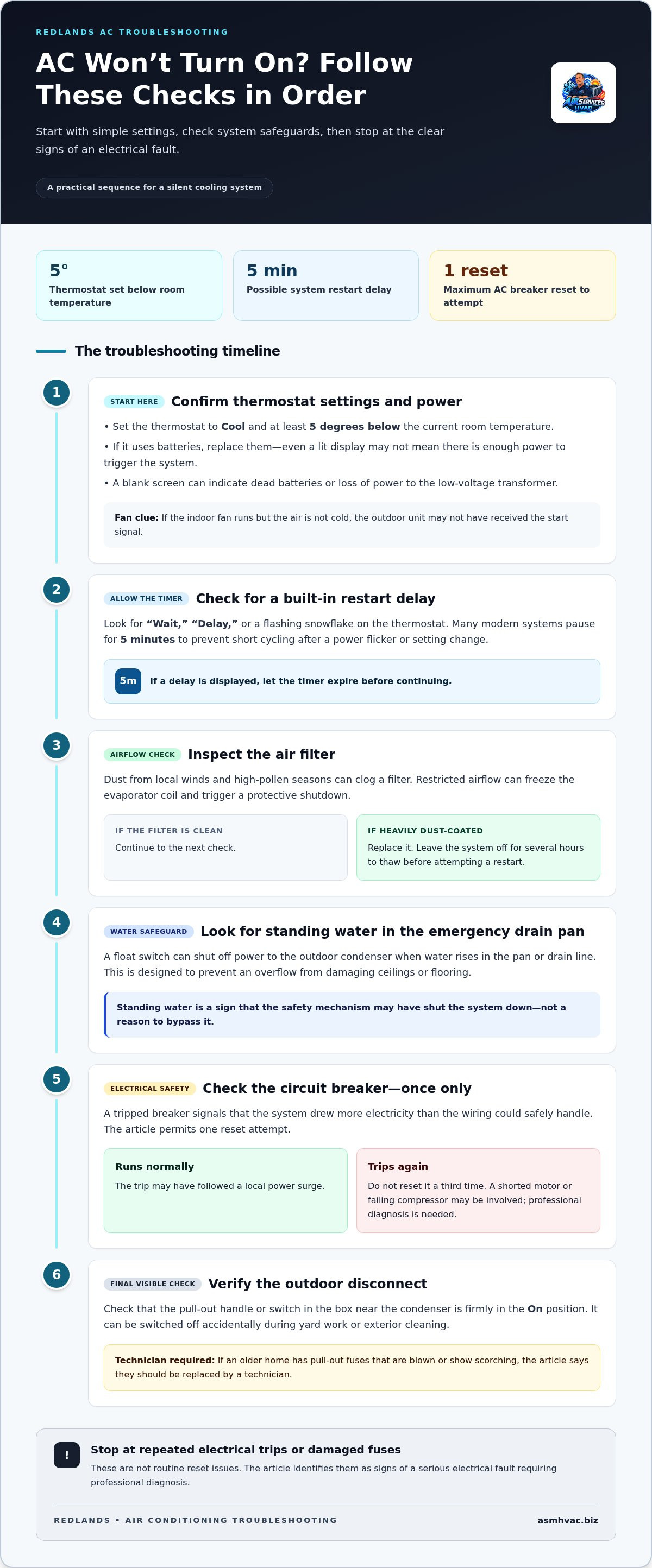
Start by confirming your thermostat is set to "Cool" and the target temperature is at least five degrees below the current room temperature. This ensures the thermostat is actually sending a "call for cooling" to the rest of the equipment. If you have a non-hardwired thermostat, replace the batteries immediately. Even if the screen appears to have power, weak batteries may lack the voltage necessary to trigger the relay that starts your air conditioner. Understanding how air conditioning systems work helps you see that even a tiny electrical interruption can halt the entire cooling process.
Checking Thermostat Settings and Power
There is a significant difference between your system's "Fan On" and "Auto" settings. If you hear the indoor fan blowing but the air isn't cold, the outdoor unit likely hasn't received the signal to start. Conversely, a completely blank thermostat screen usually indicates a total loss of power to the low-voltage transformer or dead batteries. You should also look for words like "Wait," "Delay," or a flashing snowflake icon on your display. Most modern systems include a five-minute delay to prevent "short cycling," which occurs when the system tries to restart too quickly after a power flicker or a sudden setting change. Waiting for this timer to expire often solves the issue without further intervention.
The Circuit Breaker Safety Rule
Your electrical panel is designed to be the first line of defense against electrical fires. A circuit breaker trips because it senses an "overcurrent" situation, which means the system is drawing more electricity than the wires can safely handle. You may reset a tripped AC breaker once. If the system starts and continues to run, it may have been a fluke caused by a local power surge. However, if the breaker trips again immediately or shortly after the reset, do not attempt to flip it a third time. This is a clear sign of a serious electrical fault, such as a shorted motor or a failing compressor. At this stage, you need to contact a professional for professional AC repair Redlands CA to diagnose the underlying electrical issue.
Finally, inspect the outdoor disconnect box located near your condenser unit. This box contains a pull-out handle or a switch that can sometimes be turned off by mistake during yard work or exterior house cleaning. Ensure the handle is firmly seated in the "On" position. Some older homes in the Redlands area may still use pull-out fuses in these boxes; if these fuses have "blown" or show signs of scorching, the outdoor unit will remain completely unresponsive until they are replaced by a technician.
Understanding System Safeguards: Why Your AC Shuts Down
Modern air conditioning systems are equipped with a series of protective sensors designed to prevent catastrophic mechanical failure. When you encounter an AC not turning on Redlands technicians often find that the system has entered a "safety lockout" state. This isn't a failure of the equipment itself, but rather a deliberate shutdown triggered by a safeguard. These sensors monitor everything from electrical current to internal pressures and moisture levels. If a sensor detects an environment that could lead to a burnt-out compressor or water damage to your home, it breaks the electrical circuit, leaving the unit unresponsive until the underlying issue is addressed.
One of the first things to inspect is the emergency drain pan located underneath your indoor air handler or furnace. If you see standing water in this pan, your system’s safety mechanism has likely worked exactly as intended. A small plastic device called a float switch sits in this pan or within the drain line. When water rises, the float lifts and kills power to the outdoor condenser to stop the production of more condensation. This prevents gallons of water from overflowing into your ceiling or flooring. Regular maintenance of your air conditioner is the most effective way to ensure these safeguards remain functional and that the components they protect stay clean.
The Impact of Clogged Air Filters on System Startup
Airflow is the lifeblood of your cooling system. In the Inland Empire, our high-pollen seasons and Santa Ana winds bring an abundance of dust that can quickly overwhelm a standard pleated filter. When a filter becomes severely clogged, the blower motor struggles to pull air across the evaporator coil. This causes the coil temperature to drop below freezing, leading to ice buildup. Most modern units feature a low-pressure switch that detects this drop in efficiency and shuts the system down to prevent the liquid refrigerant from "slugging" the compressor. If your system was running poorly before it stopped entirely, check the filter first. If it's coated in a thick layer of grey dust, replace it and allow the system to sit off for several hours to thaw before attempting a restart.
Clogged Condensate Drain Lines and Float Switches
Your AC doesn't just cool the air; it removes significant amounts of humidity. This moisture collects in a tray and exits your home through a PVC drain line. Over time, algae and sediment can form a "slug" that blocks this pipe. You can often locate the float switch near the indoor unit, it usually looks like a small plastic cap with wires protruding from the top. If the switch is up, the line is backed up. You can sometimes clear minor clogs by using a wet/dry vacuum on the exterior end of the drain line to pull the obstruction through. If the water returns quickly after clearing, it may indicate a more complex issue with the evaporator coil's drainage tray. For persistent drainage problems that keep your system offline, scheduling a professional preventative maintenance visit can help clear the lines and prevent future lockouts.
Technical Failures That Require Professional Diagnostic Tools
Sometimes the issue isn't as simple as a tripped breaker or a dirty filter. When you're dealing with an AC not turning on Redlands heat can push internal components past their breaking point. This is especially true for systems that have endured the record-breaking 114 degree temperatures recorded in the San Bernardino Valley during recent summers. Internal electrical failures require specialized tools, like multimeters and manifold gauges, to diagnose safely. These components are the workhorses of your system, and when they fail, the system remains unresponsive to protect itself from further damage.
The control board acts as the brain of your air conditioner, coordinating signals between the thermostat and the mechanical parts. If a relay on this board fails, the command to start the cooling cycle never reaches its destination. Similarly, a blown transformer can kill the 24V low-voltage signal entirely. This results in a blank thermostat screen and a silent system, even if your home still has power. Identifying these "brain" failures requires a methodical approach to electrical tracing that goes beyond basic troubleshooting.
Faulty Capacitors and Contactors: The Silent Killers
If you hear a distinct humming or buzzing sound coming from your outdoor unit but the fan isn't spinning, you likely have a failed start capacitor. This component acts as a temporary battery, providing the high-voltage jolt needed to kickstart the compressor and fan motors. In our local climate, extreme heat causes these components to expand and leak their internal oil, leading to failure. You must remember that capacitors store high-voltage electricity even when the power is turned off at the breaker. Attempting a DIY replacement is dangerous and can lead to severe electrical shock. The contactor is another common failure point; it's a heavy-duty switch that can "pit" or burn over time, physically preventing electricity from reaching the compressor.
Frozen Evaporator Coils and Refrigerant Issues
Low refrigerant levels often lead to a total system shutdown. When the system lacks the proper charge, the internal pressure drops, causing the evaporator coil to drop well below freezing. This leads to a solid block of ice that chokes off airflow and triggers safety sensors. While it's tempting to ask a technician to simply "top off" the system, this is a temporary fix that ignores the underlying leak. With the 2026 phase-out of R-410A refrigerant in full effect, finding and sealing leaks is more critical than ever to ensure environmental compliance and system longevity. A frozen coil requires the system to be off for 24 hours before a technician can accurately test for leaks or perform repairs.
Local Factors: Why Redlands Heat Waves Stress Your AC
Living in the San Bernardino Valley presents a unique set of challenges for cooling equipment. In September 2024, Redlands reached a record-breaking 114.1 degrees, a temperature that pushes even the most robust systems to their absolute limit. When the ambient air is that hot, your outdoor condenser struggles to shed the heat it removed from your home. This environmental stress is a leading cause of an AC not turning on Redlands residents face during peak summer months. Our local climate doesn't just demand more cooling; it physically degrades the electrical and mechanical components through extreme thermal expansion and contraction.
Beyond the heat, the Inland Empire's air quality plays a significant role in system reliability. San Bernardino County has some of the highest reported levels of ozone and pollution in the nation. These airborne particles, combined with the fine silt carried by Santa Ana winds, create a thick, insulating crust on your outdoor coils. This buildup forces the system to run longer and hotter to achieve the same cooling effect, eventually leading to a total shutdown. Investing in preventative HVAC maintenance services is the most effective way to combat these desert-adjacent environmental factors before they cause a mid-summer failure.
High Ambient Temperatures and Thermal Overload
Every AC compressor is equipped with an internal thermal overload switch. This safety device is designed to "trip" and kill power to the motor if it detects temperatures that could melt the internal windings. If you find that your system stops working during the hottest part of the afternoon but starts again once the sun goes down, your compressor is likely overheating. While providing shade for the unit can help, this symptom often suggests that the system is low on refrigerant or has a failing fan motor. If the unit remains unresponsive even after cooling down, you may need a professional to reset the system and identify why it hit that critical temperature threshold. For a reliable local diagnostic, schedule an inspection with our experienced technicians today.
Inland Empire Dust and Condenser Efficiency
A thin layer of Redlands dust might seem harmless, but it acts as a thermal blanket on your condenser coils. This prevents the refrigerant from cooling down properly, which keeps internal pressures dangerously high. You can perform basic maintenance by gently rinsing the outdoor unit with a garden hose to remove loose dirt and grass clippings. Never use a pressure washer; the high-intensity spray will flatten the delicate aluminum fins and permanently block airflow. Because our local dust is often mixed with oily pollutants, a simple water rinse isn't always enough. Professional cleaning uses specialized foaming alkaline or acidic cleaners to break down the grime deep within the coil layers, restoring the heat transfer efficiency your system needs to survive a 100-degree day.
When to Call Air Services Mechanical for AC Repair in Redlands
While basic troubleshooting can resolve minor issues, an AC not turning on Redlands residents find persistent often requires professional intervention. We believe in providing more than just a quick fix. Our team consists of NATE-certified and EPA-certified technicians who possess the specialized training required to handle complex electrical diagnostics and refrigerant management. This level of certification is essential because modern HVAC systems are increasingly sophisticated. They require a precise touch and professional-grade multimeters to ensure they operate at peak efficiency and meet the strict 2026 California energy standards.
Air Services Mechanical has spent over 20 years serving Redlands, Yucaipa, and the surrounding Inland Empire communities. We've built our reputation on a foundation of professional reliability and quiet confidence. You won't find aggressive sales tactics or hidden fees here. We provide straightforward pricing and honest assessments, prioritizing your peace of mind over a high-pressure sale. Much like how Airflix advocates for travelers during stressful flight disruptions, our team focuses on long-term results rather than temporary patches. We aim to be the dependable veteran you can rely on whenever the summer heat becomes overwhelming.
The Risks of DIY Electrical HVAC Repairs
Attempting to repair high-voltage electrical components yourself carries significant risks. HVAC systems utilize 240-volt circuits that can cause severe electrical shock or even fire if mishandled. Additionally, newer units often come with manufacturer warranties that require professional service to remain valid. An improper DIY repair could void your coverage, leaving you responsible for the full cost of a future compressor failure. A professional diagnostic doesn't just fix the immediate problem; it identifies small signs of wear, such as pitted contactors or leaking capacitors, before they become catastrophic failures.
Reliable, 24/7 Emergency AC Solutions
We know that a failed air conditioner is more than an inconvenience when temperatures stay in the triple digits. It's a safety issue for your family. We offer rapid response times for residents across Redlands and San Bernardino to ensure you aren't left in a sweltering home for long. Our technicians arrive prepared to solve the problem with integrity and transparency, acting as a steady guide through the repair process. We treat your home with the respect it deserves and maintain a clean workspace while we restore your comfort. If your troubleshooting has failed and you need a trustworthy local expert, we are ready to help. Schedule your expert AC diagnostic with Air Services Mechanical today.
Restore Your Home's Comfort with Expert Local Support
When facing an AC not turning on Redlands residents often find that the desert-adjacent heat and fine dust have simply pushed their system's safety limits. Whether it's a tripped float switch from a clogged line or a failed capacitor from a record-breaking heatwave, understanding these triggers is the first step toward a cooler home. While simple resets often work, technical electrical faults require the precision of a professional to ensure your equipment remains efficient and safe.
Air Services Mechanical brings over 20 years of local experience to every service call. As a fully licensed, bonded, and insured team, we provide the quiet confidence that comes from deep technical knowledge. Our NATE-certified technicians are ready to diagnose your system accurately, helping you avoid unnecessary part replacements while restoring your comfort quickly. This commitment to technical expertise is shared by specialized contractors like ultraairswfl.com, who provide residential and commercial climate solutions in other high-heat regions. Don't let a silent air conditioner turn your home into a furnace during the next Inland Empire heat spike.
Get Your AC Running Again: Contact Air Services Mechanical for 24/7 Emergency Repair in Redlands
We are proud to serve our neighbors and look forward to helping you stay cool through the hottest days of the year.
Frequently Asked Questions
Why is my AC thermostat screen blank and the unit won’t turn on?
A blank thermostat screen usually points to a lack of 24-volt power reaching the device. This is often caused by dead batteries in the thermostat itself or a tripped circuit breaker in your electrical panel. If those are fine, it might be a blown transformer or a safety switch that has cut power because of a secondary issue like a clogged drain line.
Can a dirty air filter really stop my AC from starting?
A severely clogged air filter is a frequent reason for an AC not turning on Redlands homeowners overlook. Restricted airflow causes the evaporator coil to drop below freezing, which triggers a low-pressure safety switch to shut the system down. Replacing your filter every 30 to 90 days is essential in our dusty Inland Empire climate.
How do I know if my AC capacitor is blown?
You can often identify a failed capacitor by a distinct humming sound coming from the outdoor unit without the fan spinning. If you look inside the service panel, a blown capacitor often appears bulged at the top or has leaked oily residue. Because these components store high-voltage electricity, they should only be tested and replaced by a certified technician.
Is there a reset button on my outdoor AC unit?
Most residential air conditioners do not have a traditional external reset button. To reset your system, you should turn the thermostat to "Off," flip the AC circuit breaker in your main panel to the "Off" position for 30 seconds, and then flip it back on. This clears the "lockout" state in the control board and allows the system to attempt a fresh start.
What should I do if my AC is humming but the fan isn’t spinning?
If you hear humming but see no movement, turn the system off at the thermostat immediately. This sound indicates that the motor is receiving electricity but cannot start, which can lead to the motor windings melting or the compressor failing. This is a clear sign that the start capacitor has failed or the motor bearings have seized.
How much does a typical AC diagnostic call cost in Redlands?
Diagnostic costs in the Redlands area generally depend on the time required to trace electrical faults and the specialized tools needed for the job. While prices vary across the Inland Empire, a professional diagnostic ensures you receive an accurate assessment of the problem. This prevents you from spending money on parts that don't actually need replacement.
What happens if my AC drain line is clogged?
A clogged drain line causes water to back up into the primary or secondary drain pan. This triggers a safety float switch that immediately cuts power to the outdoor unit to prevent water from damaging your ceilings or floors. Clearing the blockage with a vacuum or specialized tool is required before the system will restart.
When is it more cost-effective to replace the unit instead of repairing it?
Replacement is often the better choice if your system is over 10 to 12 years old and requires a major component like a compressor. With the 2026 Title 24 updates and the phase-out of older refrigerants, upgrading to a new 15.2 SEER2 unit can provide better long-term reliability. We can help you evaluate the repair-versus-replace math for your specific home.


