
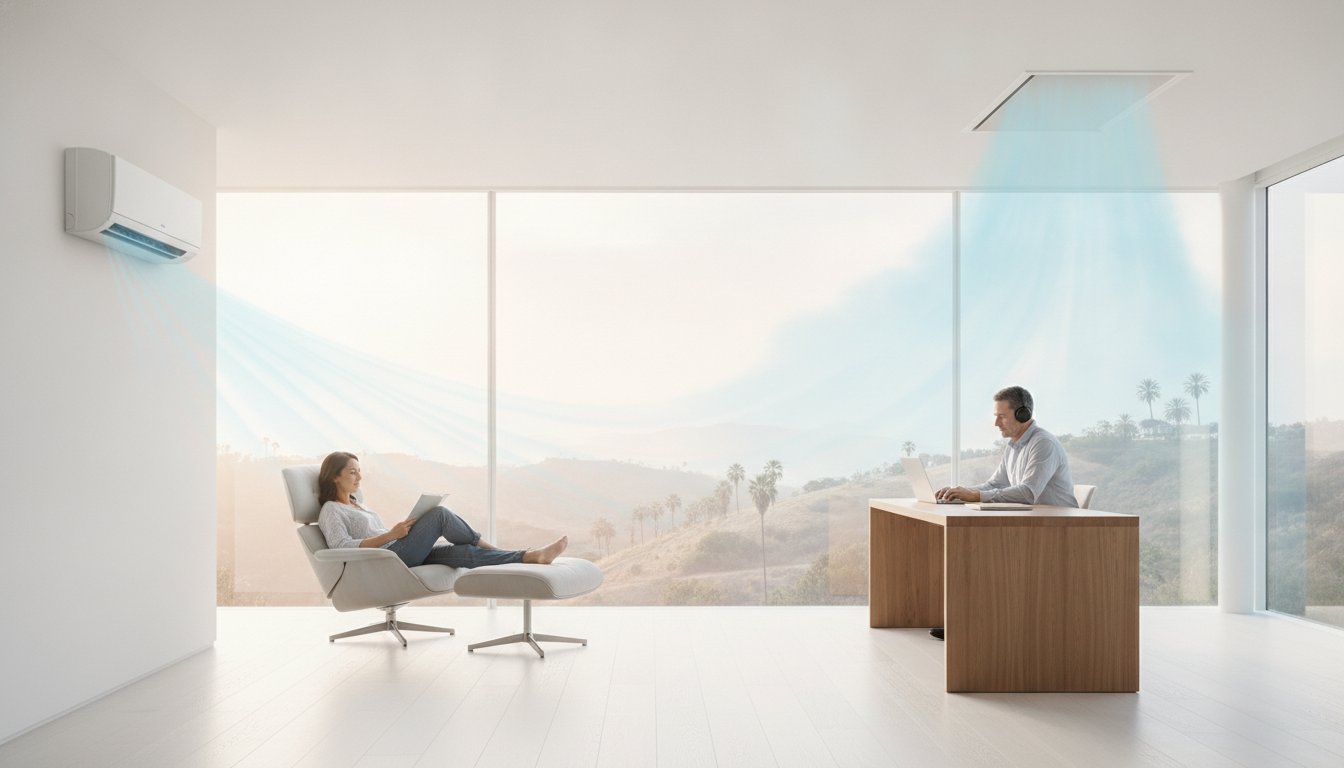
The most expensive part of your cooling system might not be the unit itself, but the energy lost through your attic before it ever reaches your living room. When you're facing another 100°F heatwave in Redlands or Riverside, the choice between a ductless mini split vs central air Inland Empire installation becomes a matter of long-term survival for your monthly budget. It's frustrating to watch your electricity bill climb while the second floor of your home stays significantly warmer than the first. You deserve a system that works as hard as you do without the constant worry of a breakdown during a Southern California summer.
We believe that home comfort should be straightforward and predictable. This comparison will help you discover the best cooling solution for your specific property by weighing energy efficiency, performance in extreme heat, and the latest 2026 Title 24 standards. We'll explain why ductless technology is often the right move for older homes with aging ductwork and how modern central air systems have adapted to California's new electrification requirements. By the end, you'll have the clear information needed to ensure consistent comfort in every room of your home.
Key Takeaways
- Learn why the extreme dry heat of the Inland Empire requires a high-performance cooling system and how your choice impacts long-term reliability.
- Understand the "zoning" advantage of a ductless mini split vs central air Inland Empire setup, which allows you to cool specific rooms and eliminate energy waste in unused spaces.
- Evaluate the benefits of a central air system for uniform temperature distribution and advanced whole-home air filtration in larger properties.
- Compare upfront installation costs against monthly utility savings while navigating the updated 2026 California Title 24 energy standards.
- Determine the right fit for your home's specific architecture, from the unique requirements of historic Redlands properties to the infrastructure of modern developments.
The Inland Empire Cooling Challenge: Why Your System Choice Matters in 2026
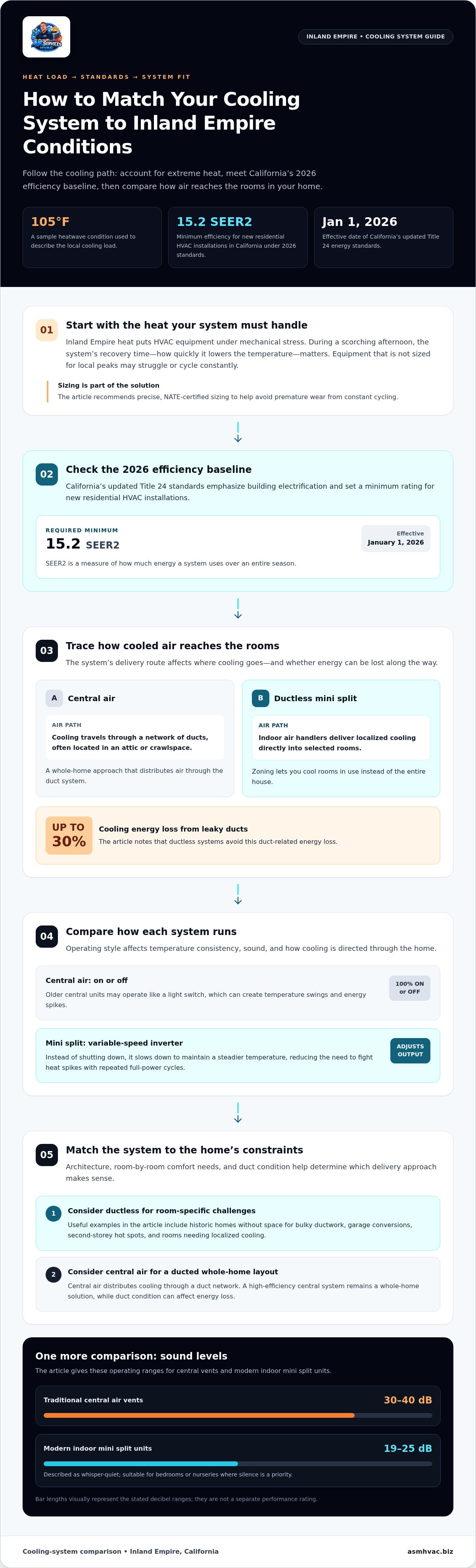
The Inland Empire heat isn't just a comfort issue; it's a mechanical stress test for your home. When comparing a ductless mini split vs central air Inland Empire residents must look at how each system handles the "cooling load" of a 105-degree week in San Bernardino. Central air systems distribute air through a network of ducts hidden in your attic or crawlspace. In contrast, ductless systems provide localized cooling directly into specific rooms via indoor air handlers. Understanding these Air conditioning systems is the first step in protecting your home's value as 2026 energy regulations take effect.
California's updated Title 24 Building Energy Efficiency Standards, which became effective on January 1, 2026, have shifted the landscape for Southern California homeowners. These rules emphasize building electrification and position heat pumps as the standard for new installations. Choosing the right system now isn't just about surviving this summer. It's about ensuring your property meets modern efficiency standards that future buyers will expect. A system that can't keep up with our regional climate will lead to higher bills and a shorter equipment lifespan.
The Impact of Inland Empire Heatwaves on HVAC Longevity
The extreme dry heat in areas like Redlands creates a unique challenge for traditional equipment. Systems often struggle with "recovery time," which is how quickly a unit can lower the temperature after a scorching afternoon. Standard units frequently underperform because they weren't sized for our local peaks. We prioritize NATE-certified sizing to ensure your equipment doesn't burn out prematurely from constant cycling. This precision prevents the common wear and tear that leads to expensive mid-summer repairs during 100-degree weeks.
SEER2 Standards and Energy Efficiency in 2026
The 2026 Title 24 standards require a minimum of 15.2 SEER2 for all new residential HVAC installations in California. SEER2 is a refined way to measure how much energy a system uses over an entire season. Ductless mini splits naturally exceed these benchmarks because they don't suffer from the energy loss typical of leaky ductwork. Research shows that leaky ducts can account for up to 30% of cooling energy loss. While a high-efficiency central system is a powerful whole-home solution, the localized nature of ductless technology often provides a faster path to lower utility bills.
Ductless Mini Splits: Precision Comfort for Modern IE Living
Ductless systems provide a level of control that traditional HVAC simply cannot match. When navigating the choice of ductless mini split vs central air Inland Empire homeowners should consider how their floor plan impacts daily airflow. The primary advantage is zoning. This technology allows you to cool only the rooms you're currently using, rather than wasting energy on an entire house. If you spend your afternoons in a home office but your upstairs bedrooms are empty, you can direct cooling exactly where it's needed. This localized approach is a primary reason why the U.S. Department of Energy emphasizes the energy efficiency of ductless systems, as they eliminate the 30% energy loss often found in leaky ductwork.
Noise is another area where these systems excel. Traditional central air vents can be loud, often operating between 30 and 40 decibels. Modern indoor mini split units are significantly quieter, typically running at a whisper-quiet 19 to 25 decibels. This makes them ideal for bedrooms or nurseries where silence is a priority. Beyond performance, the visual impact of these systems has evolved. Homeowners are no longer limited to wall-mounted units. In 2026, options like recessed ceiling cassettes and slim-duct units offer a discreet look that blends seamlessly into any interior design.
The Mechanics of Variable-Speed Inverter Technology
Older central units often operate like a light switch; they're either 100% on or completely off. This leads to uncomfortable temperature swings and high energy spikes. Mini splits use variable-speed inverters to solve this problem. Inverter technology is a method for continuous, low-energy output adjustability. Instead of shutting down, the system slows down to maintain a steady temperature. This prevents the unit from fighting the intense heat spikes common in Southern California, leading to a more consistent environment and lower wear on the hardware.
Ideal Scenarios for Ductless Systems in Southern California
Certain Inland Empire homes present unique challenges that only ductless technology can solve effectively. Many historic properties in Redlands were built long before air conditioning was standard, meaning they lack the structural space for bulky ductwork. Retrofitting these homes with central air is often physically impossible or prohibitively expensive. Ductless units only require a small three-inch hole in the wall for the conduit, preserving the architectural integrity of older homes. These systems are also perfect for:
- Garage conversions: Turning a hot garage into a livable gym or studio.
- Second-storey hot spots: Adding extra cooling power to rooms that the central system can't reach.
- Multi-generational living: Giving every family member control over their own room's temperature.
If you're dealing with uneven cooling in a multi-storey home, our team can help you design a layout using ductless mini split systems that targets your specific comfort needs.
Central Air Conditioning: The Traditional Whole-Home Powerhouse
Central air systems remain a staple for larger properties in Fontana and Rancho Cucamonga where uniform temperature distribution is the primary goal. These systems use a single high-capacity unit to push conditioned air through a network of ducts, ensuring that every corner of a 2,500-square-foot home stays at the same temperature. While the U.S. Department of Energy on Ductless Technology notes that ductless units avoid the energy losses inherent in forced-air systems, a central system offers an "invisible" aesthetic. There are no wall-mounted air handlers or ceiling cassettes to consider; only the discreet floor or ceiling vents are visible within your living space.
When weighing a ductless mini split vs central air Inland Empire homeowners should evaluate their existing infrastructure. If your property already has a functional duct network in good repair, replacing an aging central unit with a modern, high-efficiency model is often the most cost-effective path. It allows you to leverage your home's current layout while still meeting the 15.2 SEER2 standards required by 2026 regulations. This approach provides a powerful whole-home solution without the need for a complete architectural retrofit.
The Critical Role of Duct Integrity in the Inland Empire
Dust is a constant battle in Southern California. When the Santa Ana winds kick up, fine particulate matter can easily find its way into compromised or leaky ductwork. In many local homes, ducts run through uninsulated attics where temperatures can soar well above 130°F. This creates an energy "tax" as your cooled air is heated by the attic before it ever reaches your rooms. Maintaining these systems is vital for performance. We recommend regular preventative HVAC maintenance services to ensure your ducts remain sealed and your system operates at peak efficiency during our most intense heatwaves.
Advanced Air Quality and Filtration Options
Central systems offer a significant advantage for families concerned with indoor air quality. Because all air passes through a single point, it's easier to integrate high-level filtration like HEPA filters or UV light purification systems. These add-ons are particularly effective at neutralizing local allergens and the wildfire smoke that occasionally impacts the Inland Empire. For residents with severe respiratory concerns, the ability to scrub the air of an entire house simultaneously is a major benefit. Modern central systems also pair seamlessly with smart thermostats, allowing for better regional load management and more precise control over your home's environment.
Comparing Costs and Efficiency: Which System Wins the ROI Race?
The true cost of a cooling system isn't found on the price tag; it's found on your utility bills over the next decade. When analyzing a ductless mini split vs central air Inland Empire investment, you must weigh the immediate installation expense against long-term operational savings. Central air often requires a higher upfront labor investment if your existing ductwork needs significant repair or resizing to meet 2026 Title 24 standards. California labor rates for HVAC work remain approximately 35% above the national average, making the efficiency of the installation process a major factor in your total return on investment.
Installation timelines differ significantly between the two technologies. A standard multi-zone mini split system can often be installed in a single day because it requires no major construction or duct routing. In contrast, a central air retrofit involving duct replacement can take several days and requires HERS verification testing to ensure leakage is below the 5% threshold. While the federal 25C tax credit expired at the end of 2025, local incentives still exist. Southern California Edison currently offers a $75 bill credit for smart thermostat enrollment, and SoCalGas continues to provide rebates for qualifying high-efficiency appliances through December 2026.
Hidden costs often lurk in the infrastructure. Central systems face the "duct tax," where energy is lost through leaks and poor insulation in hot attics. Ductless systems avoid this entirely, but they require "line set" protection to ensure the refrigerant pipes stay insulated against the intense Southern California sun. If you're ready to see how these numbers apply to your specific floor plan, you can request a detailed quote for HVAC installation from our local team.
Energy Bill Analysis: Monthly Savings in the IE
Ductless mini split systems can be 30% to 40% more energy-efficient than central air systems. This is largely because they eliminate the energy losses associated with ductwork, which can account for up to 30% of a home's cooling consumption. In a large Inland Empire home, zoning allows you to stop cooling guest rooms or dining areas during the heat of the day. As electricity rates continue to rise, this ability to target your cooling can lead to substantial monthly savings over the 10 to 15-year lifespan of the unit.
Maintenance and Longevity Expectations
Maintenance requirements are straightforward but distinct for each system. Mini splits require you to clean the reusable filters every few weeks to maintain airflow, while central systems typically use disposable pleated filters that need changing every one to three months. Both systems require professional attention to ensure the refrigerant levels and electrical components remain stable in our harsh climate. Securing reliable AC repair Redlands CA expertise is essential for protecting your investment and ensuring your system reaches its maximum expected lifespan without a premature failure.
The Decision Framework: Choosing the Right System for Your IE Home
Your home's architectural history is often the most significant factor in the ductless mini split vs central air Inland Empire debate. In older communities like Redlands, many pre-1950s properties were built with thick plaster walls and no structural allowance for bulky ductwork. We call this the "Redlands Historic Rule." For these homes, a ductless system is almost always the superior choice because it avoids the invasive and costly process of cutting into original ceilings and closets. It preserves the home's character while providing modern, high-performance cooling that the original builders never imagined.
Conversely, the "Fontana New Build Strategy" applies to homes constructed in the last few decades. If your property was built with an existing duct network that is still in good condition, leveraging that infrastructure for a high-efficiency central heat pump is a logical move. This approach allows you to meet the 2026 Title 24 standards without the need for multiple indoor air handlers. However, we're seeing an increase in hybrid solutions. Many neighbors choose to keep their central air for the main living areas while adding a single-zone mini split to a master suite or a garage conversion to ensure those specific "hot spots" stay comfortable during July heatwaves.
Before you sign any contract, ensure your contractor performs a professional Manual J load calculation. This isn't just a suggestion; it's a requirement for a system that will actually perform when the thermometer hits 110°F. Sizing a system based on "square footage alone" is a common mistake that leads to short-cycling and premature equipment failure. A proper calculation accounts for your home's insulation, window orientation, and local Inland Empire micro-climate.
Questions to Ask Your HVAC Specialist
As you evaluate your options, start with your electrical panel. Modern heat pump technology can require more power than an old 100-amp service can provide. Ask if your current panel has the capacity for a 2026-compliant system or if an upgrade is necessary. You should also ask for a pressure test on your existing ducts. If they're a "sinkhole" for energy, even the most efficient central unit won't lower your bills. Finally, verify the warranty details. In 2026, many major brands have updated their terms to reflect the higher complexity of inverter-driven hardware.
Why Air Services Mechanical is the Inland Empire’s Trusted Guide
We've spent 20 years helping our neighbors navigate the complexities of Southern California climate control. Our NATE-certified technicians understand the specific building codes of San Bernardino and Riverside counties, ensuring your installation is fully compliant and permitted. We don't believe in high-pressure sales or unnecessary complications. Our goal is to provide a straightforward, ethical recommendation that prioritizes your comfort and your budget. Whether you need a complex multi-zone ductless layout or a high-efficiency central replacement, we're here to act as your dependable local expert.
Secure Your Home's Long-Term Comfort
Choosing the right HVAC system is an investment in your home's future value and your daily peace of mind. Whether you require the precise zoning of a ductless layout for a historic property or the robust capacity of a central system for a modern build, the decision impacts your comfort for the next decade. When deciding between a ductless mini split vs central air Inland Empire homeowners should prioritize their property's specific architectural needs and long-term energy goals. Aligning your choice with the 2026 Title 24 standards ensures you're prepared for California's shifting energy landscape.
With over 20 years of local experience, our NATE and EPA certified technicians are ready to guide you through this process with honesty and technical precision. We understand the unique demands of our regional climate and offer 24/7 emergency service to keep your family safe during the hottest weeks of the year. Take the first step toward a more efficient home today. Get a Professional Comfort Consultation from Air Services Mechanical and find the perfect cooling solution for your space. We look forward to serving you and ensuring your home remains a reliable sanctuary.
Frequently Asked Questions
Is a mini split cheaper to run than central air in the Inland Empire?
Yes, ductless systems are typically 30% to 40% more efficient than central air because they eliminate the energy loss associated with ductwork. In our local climate, you can save significantly by cooling only the rooms you occupy. This prevents the waste of pushing air through a hot attic, which often accounts for up to 30% of a central system's energy consumption.
Can a mini split really cool my entire home during a Redlands heatwave?
A multi-zone ductless system is fully capable of cooling an entire home even when temperatures exceed 100°F. By installing individual air handlers in key living areas, you ensure every room reaches its target temperature. This localized approach is often more effective than central air in multi-storey properties where upstairs rooms frequently struggle to stay cool during intense summer peaks.
How long does it take to install a ductless system versus central AC?
Most single-zone ductless installations are completed in a single day. A multi-zone system might take two days depending on the complexity of the line sets and unit placement. Central air replacements can take longer, especially if your existing ductwork requires repair or modification to meet the 2026 Title 24 standards, which often adds several days to the project timeline.
Do mini splits require more maintenance than traditional central air systems?
Maintenance requirements differ but aren't necessarily more demanding for either system. Ductless units require you to rinse the reusable filters every few weeks to maintain optimal airflow. Central systems need their pleated filters replaced every few months and require periodic duct inspections. Both systems benefit from professional preventative maintenance to ensure the electrical components and refrigerant levels remain stable in our harsh climate.
Will a mini split increase the resale value of my Inland Empire property?
Modern high-efficiency systems generally improve property value by appealing to energy-conscious buyers. In historic areas where central air is difficult to install, a professionally installed ductless system is a major selling point. It demonstrates that the property has been updated with 2026-compliant technology, providing a reliable and efficient solution for future owners who are concerned about rising utility rates.
Are there specific California rebates for switching to ductless heat pumps in 2026?
As of June 2026, many state-wide programs like TECH Clean California are no longer accepting new single-family reservations for rebates. However, Southern California Edison offers a $75 bill credit for smart thermostat enrollment. SoCalGas also provides various rebates for qualifying high-efficiency appliances installed through December 31, 2026. We recommend checking current local availability before you begin your installation project.
What happens if a mini split unit fails? Is it harder to repair than central air?
Repairing a ductless unit is not inherently harder, but it requires specialized training in inverter technology and electronic controls. One advantage is the modular nature of the system; if one indoor unit fails, the others can often continue to operate. Our technicians are trained to handle both ductless mini split vs central air Inland Empire repairs, ensuring your home stays comfortable regardless of the technology.
Can I use a mini split for heating during the San Bernardino winters?
Yes, ductless mini splits are heat pumps that provide both cooling and heating. They are highly effective during San Bernardino winters because they move heat rather than generating it through combustion. These systems remain efficient even when temperatures drop, making them a reliable year-round solution for Southern California homeowners who want to move away from traditional gas furnaces while meeting new electrification standards.


