
By January 2026, the cost of ignoring your rooftop unit involves more than just a repair bill. It means falling behind California’s strictest energy efficiency mandates in a decade. You're likely already feeling the pressure of rising utility rates during the Inland Empire's winter cold snaps, or perhaps you've faced the stress of a sudden breakdown that sent your quarterly budget into a tailspin. It's frustrating to manage tenant complaints about climate control while watching energy overhead climb. Implementing a consistent schedule for commercial heating system maintenance is the most effective way to regain control over your facility's environment and your bottom line.
We understand that your priority is a reliable building that operates without constant oversight. This guide provides a clear roadmap for seasonal upkeep to help you achieve lower utility bills and a longer equipment lifespan. You'll learn how to meet the 10 to 20 percent efficiency improvements required by the newest energy codes while deferring major capital expenditures. We've organized this checklist to give you a professional perspective on protecting your assets and ensuring your team or tenants stay comfortable all season long.
Key Takeaways
- Learn how a proactive approach to commercial heating system maintenance can reduce energy consumption by up to 15% and lower your facility's monthly overhead.
- Discover why October is considered the "Golden Month" for heating preparation in San Bernardino and Redlands to ensure reliability before the first cold snap.
- Understand how precise Building Management System (BMS) calibration and MERV-rated filtration protect both indoor air quality and tenant comfort.
- Find out how moving to a structured maintenance cycle can extend the life of your heating assets from 15 years to 25 years, deferring major capital expenditures.
- Identify the specific professional certifications and standards required to handle complex commercial-scale HVAC equipment with technical precision.
The Business Case: Why Commercial Heating Maintenance is a Financial Necessity
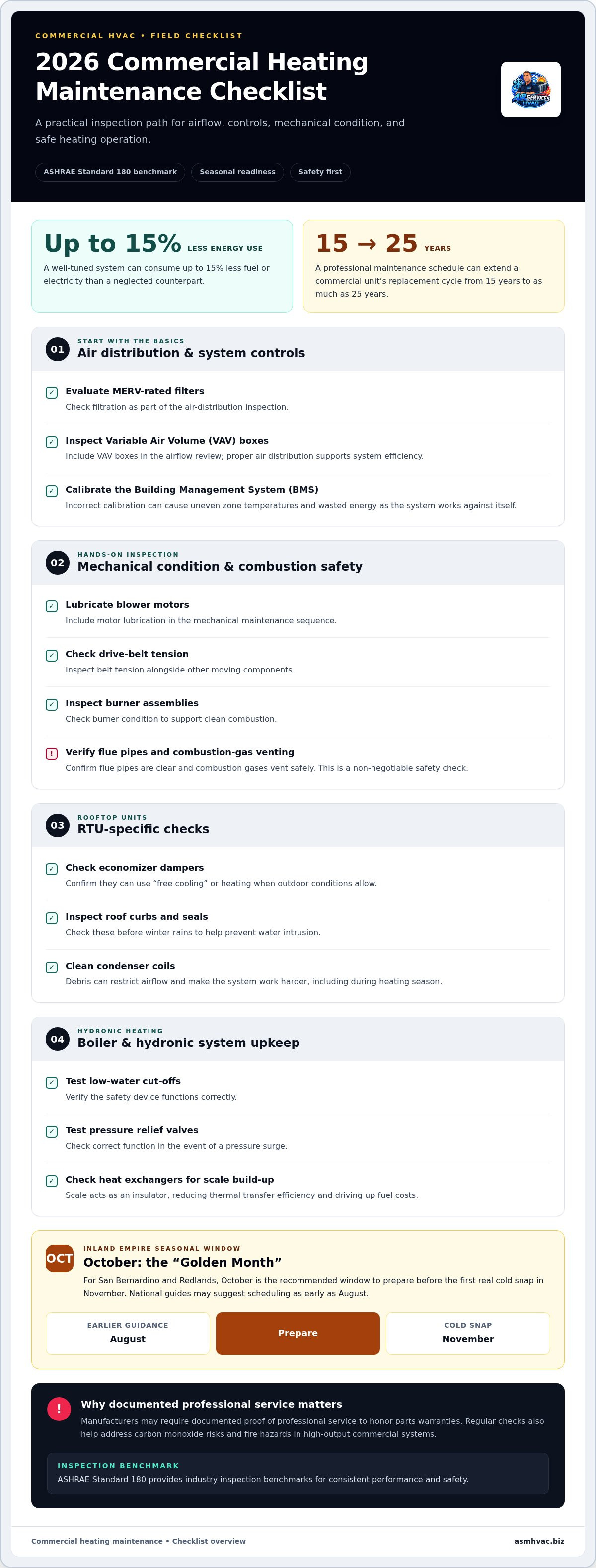
A proactive approach to commercial heating system maintenance is a strategic financial decision that protects your facility's bottom line. A well-tuned system operates with maximum efficiency, typically consuming up to 15% less fuel or electricity than a neglected counterpart. This reduction in overhead directly impacts your monthly operating costs. Proper Heating, ventilation, and air conditioning (HVAC) management also includes protecting the physical asset itself. By adhering to a rigorous professional schedule, facilities managers can often extend the replacement cycle of a commercial unit from 15 years to as much as 25 years.
To better understand the technical depth of these services, watch this overview of professional upkeep:
Manufacturers are increasingly strict about warranty claims. Most brands require documented proof of professional service to honor parts warranties. Skipping even one season could mean paying out of pocket for a failed heat exchanger that should have been covered by the maker. Beyond the financial implications, regular checks mitigate liability by addressing carbon monoxide risks and fire hazards inherent in high-output commercial systems.
Mitigating liability is a multifaceted responsibility, extending from physical safety to ensuring that all individuals have equal access to services; for those seeking legal support regarding these standards in other regions, ADA Help - NY disability discrimination claims provides a free case check for individuals navigating discrimination issues in New York.
Protecting Operational Continuity
For a retail center or office park in Redlands, a single "down day" due to a heating failure can result in thousands of dollars in lost productivity or tenant revenue. Consistent care is the best defense against these interruptions. It ensures your system remains reliable throughout the winter and significantly reduces the need for emergency heating repair during peak demand periods.
The "If It Ain’t Broke" Fallacy
Many business owners assume a quiet system is a healthy one. This is a common misconception. Aging commercial units often suffer from "ghost" inefficiencies, where components work harder to compensate for dirty coils or worn belts. You won't hear these problems, but you'll see them reflected in your utility bills. Professional commercial heating system maintenance identifies these invisible drains on your budget before they lead to a total system collapse.
The Essential 2026 Commercial Heating Maintenance Checklist
Effective commercial heating system maintenance follows a structured path that aligns with industry benchmarks like ASHRAE Standard 180. This standard ensures that your facility meets minimum inspection requirements for consistent performance and safety. Start your inspection with air distribution by evaluating MERV-rated filters and Variable Air Volume (VAV) boxes. Proper airflow is the foundation of efficiency. If your Building Management System (BMS) isn't calibrated correctly, your system will fight against itself, leading to uneven zone temperatures and wasted energy across your facility.
Mechanical integrity requires a hands-on approach. Technicians should lubricate blower motors, check the tension on drive belts, and conduct a thorough inspection of burner assemblies to ensure clean combustion. Safety remains the highest priority, which is why verifying that flue pipes are clear and combustion gases are venting safely is a non-negotiable step. If you're unsure when your last professional inspection occurred, a quick review of our commercial HVAC services can help you establish a baseline for your facility's health.
Rooftop Unit (RTU) Specifics
RTUs are common across Inland Empire commercial landscapes. It's vital to check economizer dampers to ensure they're utilizing "free cooling" or heating when outdoor conditions allow. Inspecting roof curbs and seals now is essential to prevent water intrusion during winter rains. Condenser coils require cleaning even in the heating season because debris accumulation restricts airflow and forces the system to work harder regardless of the operating mode.
Boiler and Hydronic System Upkeep
For buildings using hydronic heat, safety compliance is paramount. Regularly test low-water cut-offs and pressure relief valves to ensure they function correctly during a pressure surge. Scale build-up in heat exchangers acts as an insulator, significantly reducing thermal transfer efficiency and driving up fuel costs. Maintaining these components ensures your boiler remains a reliable heat source while meeting the 10 to 20 percent efficiency improvements required by 2026 energy codes.
Implementing a Maintenance Strategy in the Inland Empire
In the Inland Empire, timing is everything. While many national guides suggest scheduling service as early as August, October is the true "Golden Month" for our region. Temperatures in San Bernardino and Redlands finally begin to dip, providing the perfect window to prepare your system before the first real cold snap in November. Effective commercial heating system maintenance also requires a customized strategy. You shouldn't treat a high-traffic retail lobby the same as a low-use warehouse space. Tailoring your filter changes and mechanical inspections to specific zone usage prevents over-servicing while ensuring your most critical areas remain comfortable.
Reliability depends entirely on the expertise of the person opening the cabinet. Always verify NATE and EPA certifications for any technician handling your commercial-scale equipment. These credentials are the industry standard for technical proficiency and environmental safety. Beyond the physical work, maintain a meticulous service log. This documentation isn't just for your records; it satisfies insurance requirements and increases property resale value by proving the mechanical assets were cared for with professional discipline.
Choosing a Local Service Partner
Navigating specific building codes in Redlands requires a partner with deep local roots. With over 20 years of experience in the area, we understand how our local climate affects equipment wear and tear. We prioritize "Straightforward Pricing" because it offers the budget certainty facility managers need, unlike the unpredictable nature of open-ended hourly bids. This is also an excellent time to bundle your upkeep with commercial ventilation services to ensure your indoor air quality remains high throughout the winter months.
Moving Toward Predictive Maintenance
The industry is shifting toward data-driven care. Smart sensors can now detect subtle vibration or temperature changes that signal a problem before a total failure occurs. At Air Services Mechanical, we use these diagnostic tools to provide facility leads with "quiet confidence." You don't have to guess if your rooftop unit will survive a freeze. Instead, you'll have clear, actionable data that lets you stay ahead of repairs and manage your assets with professional ease.
This data-driven approach is also vital for other critical infrastructure; for example, the maintenance and refurbishment of heavy industrial rotating equipment by Kelsey Machine Services helps facility managers avoid catastrophic failures in non-HVAC systems.
Securing Your Facility’s Comfort and Compliance
Mastering your building's climate starts with moving from reactive repairs to a disciplined, proactive strategy. You've seen how a thorough checklist prevents the invisible inefficiencies that drive up utility costs and how proper timing in the Inland Empire protects your long-term mechanical assets. By prioritizing commercial heating system maintenance, you aren't just checking a box; you're extending the life of your equipment and ensuring your tenants or employees stay focused on their work rather than the thermostat.
This commitment to facility excellence is a hallmark of professional environments, similar to the high standards maintained by Citizens Business Center in their executive suites and private offices.
While maintaining your physical facility is a priority, ensuring your digital infrastructure is automated and professional is just as vital for long-term success; for expert web design and hosting, check out Ultimate Info Services.
At Air Services Mechanical, we provide the technical precision required to keep your building running smoothly through every cold snap. With over 20 years of local expertise and a team of NATE-certified technicians, we offer the quiet confidence you need to manage your facility without unnecessary stress. Whether you require a routine seasonal check or 24/7 emergency commercial support, we're here to help. Schedule Your Commercial Heating Tune-Up with Air Services Mechanical today to protect your assets and your quarterly budget. We look forward to being your dependable partner in maintaining a comfortable, efficient workspace.
Common Questions About Commercial Heating Upkeep
How often does a commercial heating system really need maintenance?
Most facilities require professional service at least once per year to ensure reliability. In the Inland Empire, scheduling this in October ensures your system is ready for the first winter cold snap. High-traffic buildings or industrial spaces with significant dust may benefit from quarterly filter changes and mechanical inspections to maintain peak efficiency and air quality throughout the year.
What is the difference between residential and commercial heating maintenance?
The primary differences are the scale of the equipment and the complexity of the controls. Commercial systems often utilize rooftop units, specialized economizers, and Building Management Systems that regulate multiple zones. These components require a higher level of technical training and specialized diagnostic tools, such as those provided by Zenith Sales & Calibrations Pty Ltd, compared to the simpler, single-zone furnaces typically found in residential homes.
Can my in-house janitorial staff perform heating maintenance?
While janitorial teams can assist with basic visual checks or simple filter replacements, they shouldn't perform technical commercial heating system maintenance. Tasks involving high-voltage electrical components, gas pressure calibration, and refrigerant handling require NATE and EPA certifications. Relying on certified professionals ensures your equipment remains safe, compliant with local codes, and covered under manufacturer warranties.
How long does a typical commercial heating tune-up take?
A standard inspection and tune-up for a single commercial rooftop unit or furnace usually takes two to four hours. The total time for your facility depends on the number of units and the complexity of your air distribution system. We focus on being thorough rather than rushing, ensuring every belt, motor, and burner is checked with professional ease.
What are the signs that my commercial heater needs immediate repair instead of just maintenance?
Immediate attention is necessary if you notice unusual sounds like grinding or loud pops, or if you see a yellow burner flame instead of a steady blue one. Frequent cycling, where the heater turns on and off constantly, is another red flag. These symptoms suggest a mechanical failure or safety risk that routine maintenance won't solve on its own.
Is a service contract required for commercial maintenance in Redlands?
A long-term service contract isn't a requirement for professional upkeep. We believe in providing business owners with flexibility and straightforward pricing without the need for restrictive agreements. You can schedule your maintenance as needed or set up a recurring plan that fits your specific budget and facility requirements without any high-pressure sales tactics.


