

The lowest bid you receive for your HVAC unit replacement cost might actually be the most expensive mistake you make for your home this year. It's common to feel overwhelmed by rising energy bills and the complexity of modern efficiency standards, especially as older R-410A systems become more costly to maintain. You deserve a straightforward explanation of what a new installation entails without the fear of hidden fees or high-pressure sales tactics. We understand the unique challenges of keeping a home comfortable in the Inland Empire heat while navigating new refrigerant mandates and local building codes.
This guide provides a clear, expert breakdown of the expenses you'll face in 2026, from equipment types to specific labor factors in Redlands and the surrounding areas. We'll explore how Title 24 standards impact your budget and which local utility rebates are still available to help offset your investment. You will learn the functional differences between heat pumps and traditional furnaces to determine the best fit for your property. By the end of this article, you'll have the technical knowledge and pricing context needed to budget with confidence and ensure long-term reliability for your home.
Key Takeaways
- Understand the typical 60/40 split between hardware and labor to ensure you're receiving a fair and transparent installation quote.
- Learn how regional Title 24 standards and local climate demands directly impact your total HVAC unit replacement cost in 2026.
- Use the "$5,000 Rule" to calculate whether repairing your current system or investing in a high-efficiency unit offers the best return on investment.
- Discover which Southern California utility rebates and low-interest financing options are still active to help manage your project budget.
- Get clarity on the mandatory shift to new refrigerants and how these 2026 industry changes affect your system's long-term maintenance.
Breaking Down the Components of HVAC Unit Replacement Cost
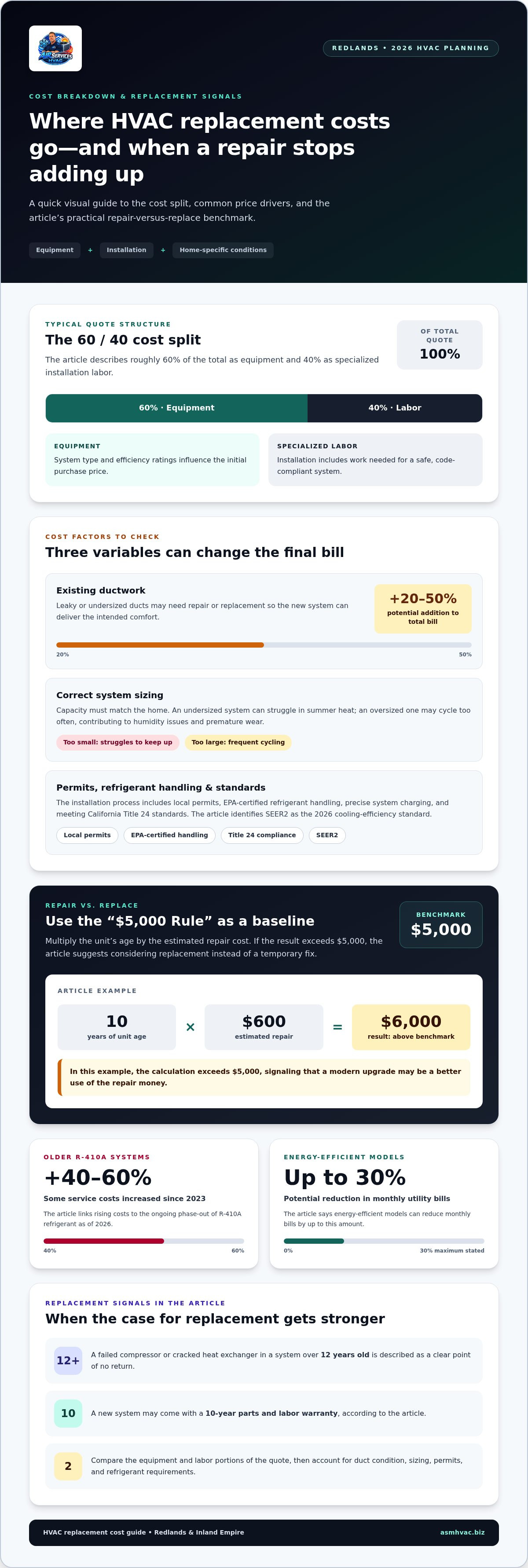
When you receive a quote for your home, it's helpful to understand that the total HVAC unit replacement cost typically follows a 60/40 split. Roughly 60% of your investment covers the physical equipment, while the remaining 40% accounts for the specialized labor required for a safe, code-compliant installation. Understanding the basic mechanics of Heating, ventilation, and air conditioning (HVAC) systems helps clarify why this balance is necessary for long-term performance and home safety.
To better understand how these costs are calculated and what to look for in a quote, watch this helpful video:
Sizing is critical in the Inland Empire. A system that's too small will struggle against the San Bernardino summer heat, while one that's too large will cycle on and off too frequently, leading to humidity issues and premature wear. This capacity is measured in tonnage and must be matched precisely to your home's square footage. Additionally, the condition of your existing ductwork plays a major role in the final price. If your ducts are leaky or undersized, repairing or replacing them can add 20% to 50% to your total bill, but it's often necessary to ensure the new unit actually delivers the comfort you're paying for.
Equipment Types and Their Price Tiers
In Redlands, many homeowners still rely on the traditional central air and furnace combination. However, the 2026 shift toward electrification has made high-efficiency heat pumps a primary choice for those looking to modernize. For homes with specific cooling needs or older structures without existing ducts, ductless mini-split systems offer a flexible alternative. Each tier offers different levels of SEER2 and HSPF2 ratings, which directly influence the initial purchase price.
Labor, Permits, and Disposal Fees
Expert installation involves more than just swapping boxes. It requires local permits, EPA-certified refrigerant handling, and precise system charging to meet California's Title 24 standards. SEER2 is the 2026 standard for measuring cooling efficiency. While it might be tempting to look for the cheapest labor available, non-certified installs often lead to higher energy consumption or premature part failure. Choosing NATE-certified technicians ensures that your HVAC unit replacement cost is a one-time investment rather than the start of a cycle of expensive repairs.
The Repair vs. Replace Decision: Calculating Your ROI
Deciding whether to fix a failing system or commit to the total HVAC unit replacement cost is a significant financial crossroads. Many industry veterans suggest the "$5,000 Rule" as a practical baseline for this choice. You simply multiply the age of your unit by the estimated cost of the repair. If the result exceeds $5,000, the investment is likely better directed toward a new system. For instance, a $600 repair on a 10-year-old unit equals $6,000, which signals that your money is better spent on a modern upgrade than a temporary fix.
This "cut your losses" logic applies to many high-cost assets; just as it is often more financially sound to sell a non-running vehicle to Cash For Junk Cars Michigan than to pay for a major engine overhaul, choosing to replace a failing HVAC unit helps you stop wasting money on a system that has effectively become junk.
Beyond the immediate repair bill, you must consider the "ghost costs" associated with keeping an obsolete unit. As of 2026, the ongoing phase-out of R-410A refrigerant has caused service prices to climb, with some costs increasing by 40% to 60% since 2023. Sinking money into a leaking, older system often leads to a cycle of expensive, recurring service calls. While the upfront HVAC unit replacement cost can feel daunting, choosing energy-efficient models can reduce your monthly utility bills by up to 30%, allowing the new system to pay for itself over the coming years.
When Replacement is the Only Logical Financial Move
Certain mechanical failures are terminal. A cracked heat exchanger or a failed compressor in a system over 12 years old represents a clear "point of no return." With the rising price of specialized parts and the increasing scarcity of older refrigerants, these repairs often reach half the value of a new unit. In these scenarios, a fresh energy efficient HVAC installation provides the most security and financial sense.
Long-Term Value and Home Equity
While upgrading your HVAC system is a key internal investment, many homeowners also focus on exterior surfacing to maximize their property's market appeal; for inspiration on high-quality decorative solutions, you can check out Scott Patterned Concrete.
A new system is more than just a cooling solution; it's a direct boost to your property's market value. Buyers in the Inland Empire prioritize reliable, modern climate control when searching for homes. You also move from having zero coverage on an old unit to enjoying a 10-year parts and labor warranty. To keep that new investment running at peak performance, scheduling regular preventative HVAC maintenance services is essential. If you're unsure about your unit's current health, you can request a professional system evaluation to see if a repair is truly a viable long-term option.
How to Save on Your 2026 HVAC Replacement in Redlands
Managing your HVAC unit replacement cost requires a strategic approach to local incentives and timing. While the primary federal tax credits under Section 25C expired at the end of 2025, homeowners in the Inland Empire still have access to significant regional programs. For instance, LADWP customers can stack active rebates up to $10,220 for specific heat pump installations. Southern California Edison (SCE) customers can access the GoGreen Home Energy Financing program, which offers below-market interest rates to help spread out the investment. Checking with SoCalGas is also vital, as they currently offer rebates of approximately $2,000 for qualifying high-efficiency natural gas furnaces.
Timing your installation can also impact your bottom line. Scheduling work during the "shoulder seasons" of spring or fall often results in more flexible scheduling and competitive pricing compared to the peak summer rush. It's also critical to hire NATE certified HVAC technicians. Many manufacturer rebates and utility programs specifically require professional installation by certified experts to validate the equipment's performance and efficiency claims.
Strategic Sizing for the Southern California Climate
A common mistake in Redlands is falling into the "oversizing" trap. A larger unit isn't necessarily better for managing the intense heat of our region. Systems that are too large will cycle on and off rapidly, which wastes energy and fails to maintain a consistent temperature. By addressing minor issues through AC repair Redlands CA and improving home insulation, you might actually find that a smaller, more affordable unit meets your needs perfectly while keeping your HVAC unit replacement cost lower.
Financing and Straightforward Pricing
Transparency is the foundation of a dependable contractor relationship. You should look for professionals who provide clear, upfront quotes that break down equipment and labor without hiding costs inside complex service contracts. We understand that a cooling failure in the middle of a heatwave isn't just an inconvenience; it's an emergency. Seeking out providers with 24/7 emergency support ensures that if a replacement becomes an immediate necessity, you won't be left waiting in the heat. This dependability, alongside proper property protection, helps you manage your budget with the peace of mind that the job is done right the first time; for those considering their long-term coverage needs, you can discover SI Insurance.
Secure Your Home Comfort for the Next Decade
Planning for your HVAC unit replacement cost doesn't have to be a source of stress. By understanding the balance between equipment quality and certified labor, you've already taken the first step toward a more efficient home. Remember that the right decision involves more than just the lowest bid. It's about matching a system to the specific demands of the Inland Empire climate and securing available rebates while they're still active. Whether you're navigating the shift to new refrigerants or deciding if a heat pump is right for your property, your focus should remain on long-term reliability and energy savings.
At Air Services Mechanical, we bring over 20 years of Redlands HVAC expertise to every project. Our NATE and EPA certified technicians prioritize straightforward pricing with no hidden fees, ensuring you receive a system sized perfectly for your needs. We're here to act as your dependable guide through every stage of the installation process. Request a Transparent HVAC Replacement Estimate from Air Services Mechanical today to start your journey toward a more comfortable, energy-efficient home. You can face the upcoming summer heat with complete confidence.
Frequently Asked Questions
What is the average HVAC unit replacement cost for a 2,000-square-foot home in 2026?
The total HVAC unit replacement cost for a 2,000-square-foot home in the Inland Empire typically trends toward the higher end of the California average due to our extreme cooling demands. While national averages vary widely, local homeowners should budget for a system that meets strict Title 24 energy standards. This investment generally includes the outdoor condenser, indoor air handler or furnace, and the specialized labor required for a precise, high-heat installation.
Is it cheaper to replace the furnace and AC at the same time?
Yes, replacing both the furnace and the air conditioner simultaneously is almost always more cost-effective than doing them separately. You save significantly on labor because the installation team only needs to prep the site and secure permits once. Additionally, installing a matched system ensures that all components are designed to communicate perfectly, which prevents the efficiency losses often seen when pairing new technology with an aging furnace.
How much can I save with federal tax credits for a new heat pump?
Federal tax credits under Section 25C, which previously offered up to $2,000 for qualifying heat pumps, expired on December 31, 2025, and are not available for 2026 installations. However, you can still find substantial savings through local utility programs. For example, LADWP customers may access up to $10,000 in active rebates for certain heat pump installs, while other providers offer low-interest financing to help manage your HVAC unit replacement cost.
What are the most common factors that cause an HVAC quote to increase unexpectedly?
Unexpected price jumps are usually caused by hidden infrastructure needs, such as a main electrical panel that requires an upgrade to support a modern unit. Other common factors include the discovery of asbestos in old insulation or ductwork that is too small for the airflow of a high-efficiency system. Choosing a contractor who performs a detailed load calculation and site survey before providing a quote is the best way to avoid these surprises.
Should I replace my ductwork when I get a new HVAC unit?
You should consider replacing your ductwork if it is over 15 years old or if a professional test reveals air leakage exceeding 15%. Modern high-efficiency systems depend on precise airflow to reach their rated SEER2 levels. If your existing ducts are collapsed, leaky, or improperly sized, your new unit will work harder and wear out faster. A duct inspection ensures your home actually feels the comfort you're paying for.
How long does a typical HVAC unit replacement take to install?
A standard equipment swap usually takes between eight and fourteen hours, often completed in a single day. If your project involves more complex work, such as installing a new duct system or transitioning from a gas furnace to an electric heat pump, the timeline can extend to two or three days. We always provide a clear schedule before work begins so you can plan for the temporary interruption to your home's climate control.


