

A refrigerant leak isn't just a minor maintenance issue; it's a structural failure that can lead to a catastrophic compressor breakdown if left unaddressed. When you're facing a Redlands heatwave and your vents start blowing lukewarm air, it's natural to feel frustrated and worried about the potential cost of an AC refrigerant leak repair. You likely already know that a cooling system should be a closed loop, meaning any loss of refrigerant points to a physical hole or crack that requires professional attention rather than a simple, temporary top-off.
We understand the stress of watching your electricity bills climb while your home's comfort levels drop. This guide will help you confirm the specific warning signs of a leak and walk you through the professional diagnostic process. You'll also find a clear framework to help you decide whether a targeted repair or a full system replacement is the most ethical and cost-effective choice for your home's long-term comfort and peace of mind.
Key Takeaways
- Recognize physical red flags like warm air from vents or unusual hissing sounds that indicate your system's sealed loop has been compromised.
- Understand why a professional AC refrigerant leak repair is a structural necessity rather than simply "topping off" the system with more coolant.
- Learn about advanced diagnostic methods, including electronic sniffers and UV dye testing, that technicians use to pinpoint precise leak locations.
- Apply the "50% Rule" to determine if repairing your current unit is a sound financial investment or if a full replacement is more practical.
- Discover how the age of your system and local Inland Empire cooling demands influence the long-term success of leak repairs.
The Homeowner’s Diagnostic Checklist: Signs of a Refrigerant Leak
In Redlands, the intense summer heat puts incredible strain on your cooling system. When the temperature spikes, your air conditioner must work at peak capacity for hours. This cycle of extreme heat and cooling causes copper lines to expand and contract repeatedly, which can eventually lead to microscopic cracks. To understand the severity, it helps to know What is AC refrigerant? and how it functions as the lifeblood of your cooling system. Because this fluid is responsible for moving heat out of your home, any loss in the loop causes immediate performance issues.
- AC Blowing Warm Air: You might notice the outdoor unit running non-stop, but the air coming from your vents feels room temperature. This happens because there isn't enough refrigerant to absorb the heat from your indoor air.
- Unexplained Hissing or Bubbling: Small leaks often produce a distinct hissing sound near the indoor evaporator coil. Larger leaks, or those involving liquid refrigerant, may sound like bubbling or gurgling.
- Ice Formation on Copper Lines: It sounds counterintuitive. However, a leak causes the remaining refrigerant to drop below freezing temperatures, turning the humidity in your home into a layer of ice on the coils.
- Spiking Energy Bills: When levels are low, the system loses efficiency. You'll see a sharp increase in your utility costs as the unit runs longer to achieve the same cooling effect.
The "Telltale Three" Symptoms
The combination of warm air, ice on the lines, and strange noises constitutes the "Telltale Three" of a system leak. These symptoms frequently appear together during the peak of a Redlands afternoon when cooling demands are highest. If you see ice while hearing a hiss, your system is likely experiencing a significant loss of pressure that requires a professional AC refrigerant leak repair before the unit fails completely.
Why "Topping Off" is Not a Solution
Air conditioning systems are designed as closed loops; they don't "use up" refrigerant like a car uses gas. If your levels are low, there's a physical hole in the line or coil that must be sealed. Simply adding more gas is a temporary band-aid that ignores the underlying damage. Delaying a proper AC refrigerant leak repair forces your system to run under high stress, which often results in an expensive AC compressor replacement later on.
Professional Detection: How Technicians Find and Fix Leaks
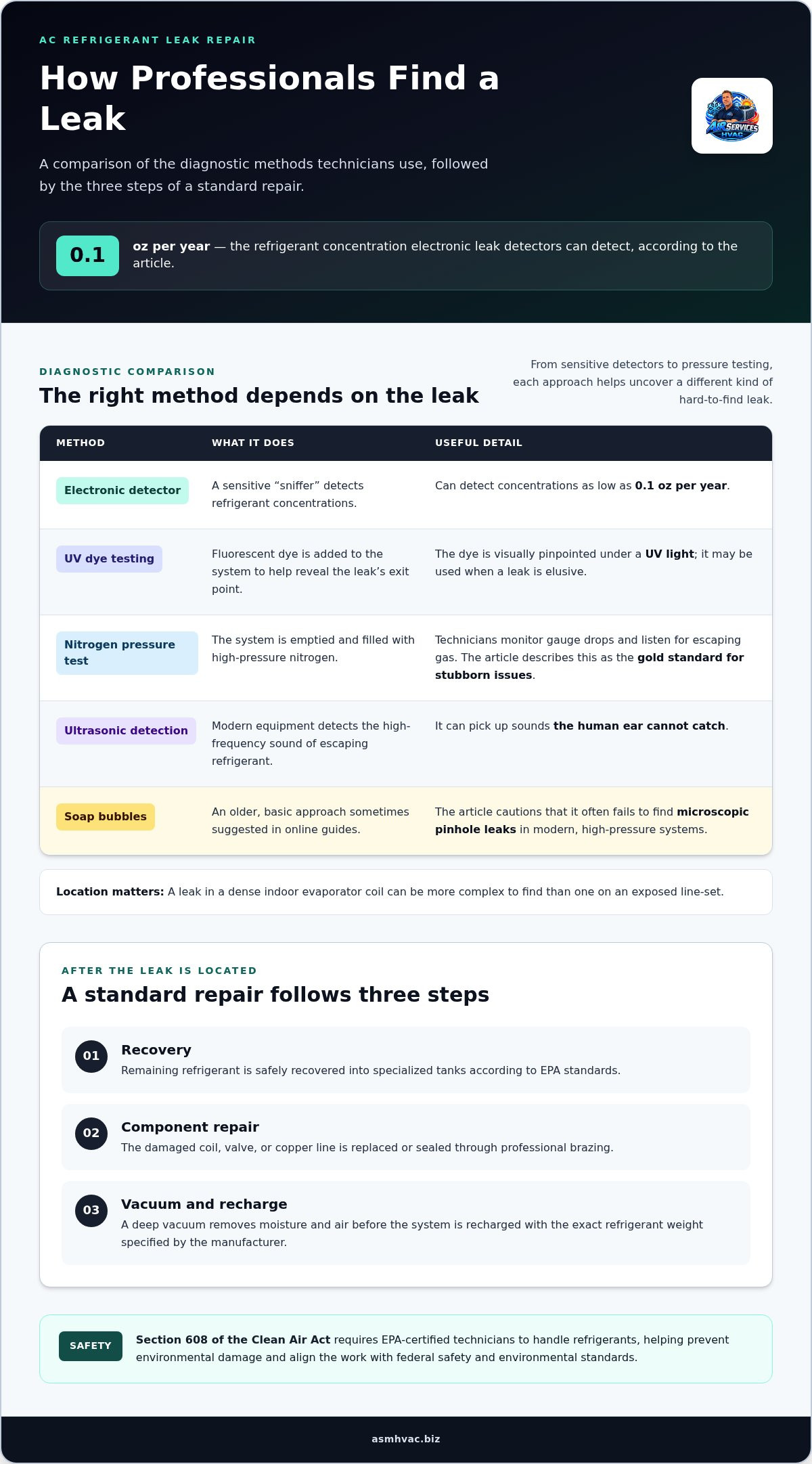
Finding a leak requires more than just a quick look under the hood. While some online guides suggest using soap bubbles, this "old school" method often fails to find the microscopic pinhole leaks common in modern, high-pressure systems. Professional technicians utilize advanced tools to ensure a precise AC refrigerant leak repair. Electronic leak detectors, often called "sniffers," are highly sensitive devices capable of detecting refrigerant concentrations as low as 0.1 oz per year. If a leak remains elusive, we might use Ultraviolet (UV) dye testing, where a fluorescent dye is injected into the system to visually pinpoint the exit point under a UV light.
For the most stubborn issues, nitrogen pressure testing is the gold standard. We empty the system and fill it with high-pressure nitrogen to monitor gauge drops and listen for escaping gas. Beyond the technical challenge, there is a legal mandate to consider. Section 608 of the Clean Air Act requires that only EPA-certified technicians handle refrigerants to prevent environmental damage. This ensures that every step of the process aligns with federal safety and environmental standards.
Advanced Detection Methods
Modern ultrasonic detection allows professional AC repair Redlands CA teams to hear the high-frequency sound of a leak that the human ear simply can't catch. Locating a leak within the indoor evaporator coil is significantly more complex than checking an exposed line-set, as the coil's dense fins can hide small fractures. If you suspect your system is losing pressure, you can consult with a certified specialist to determine the best diagnostic approach.
The Repair Process Steps
A standard repair follows a disciplined three-step sequence to ensure long-term reliability.
- Step 1: Recovery. We safely recover any remaining refrigerant into specialized tanks according to EPA standards.
- Step 2: Component Repair. The damaged section, whether a coil, valve, or copper line, is either replaced or sealed through professional brazing.
- Step 3: Vacuum and Recharge. Technicians pull a deep vacuum on the system to remove moisture and air before recharging it with the exact weight of refrigerant specified by the manufacturer.
Repair vs. Replace: Making the Right Financial Decision
Deciding whether to invest in an AC refrigerant leak repair or replace the entire system is a significant financial choice. We recommend using the "50% Rule" as a practical starting point. If the estimated repair cost exceeds half the value of your existing unit, a replacement is usually the more responsible investment. This guideline is particularly relevant for systems in the Inland Empire that are 10 to 12 years old. Once a leak develops in an older unit, other major components often begin to fail shortly after due to the stress of previous low-refrigerant cycles.
The specific refrigerant your system uses also dictates the logic of the repair. In 2026, R-22 is extremely scarce and expensive because its production was banned years ago. Even R-410A has seen price increases of 30% to 50% recently due to the AIM Act regulations. Investing heavily in a phased-out refrigerant is often a temporary fix for an obsolete system. Instead, a new energy efficient HVAC installation can pay for itself through significantly lower monthly utility bills and modern reliability.
The Cost of Delay
Ignoring a small leak rarely ends well for a homeowner. A minor fracture can quickly escalate into an emergency AC repair Yucaipa situation when temperatures hit triple digits on a holiday weekend. If refrigerant levels get too low, you risk a condition called "slugging," where liquid refrigerant enters the compressor. This can destroy the heart of your air conditioner, turning a repairable leak into a total system failure.
Inland Empire Climate Considerations
The Southern California desert climate is particularly harsh on mechanical equipment. High thermal expansion from extreme daily temperature swings puts immense stress on copper joints and evaporator coils. Because of these local conditions, preventative HVAC maintenance services are essential for longevity. Regular inspections allow us to catch microscopic leaks before they force a total shutdown during the peak of summer.
Protecting Your Home’s Comfort and Efficiency
Recognizing the early warning signs of a leak is the first step toward avoiding a total system failure during the next heatwave. Whether you have noticed ice on your copper lines or a sudden spike in your utility bills, addressing the problem promptly protects the heart of your air conditioner. By understanding the diagnostic process and applying the 50% rule, you can make a confident decision that balances immediate costs with long-term reliability. A timely AC refrigerant leak repair preserves your system's efficiency and prevents the cascading damage that often follows low pressure levels.
Our team provides the local expertise needed to handle these complex mechanical issues with integrity. We offer NATE-certified expertise and a 24/7 emergency service in Redlands to ensure you never have to wait for relief. As a licensed, bonded, and insured provider, we prioritize your peace of mind and the safety of your home. You can Schedule a Professional Leak Detection with Air Services Mechanical to get a clear, honest assessment of your unit's health. We are here to help you maintain a cool and comfortable home all year long.
Frequently Asked Questions
Is it worth fixing a refrigerant leak in a 10-year-old AC?
Deciding whether to repair a 10-year-old unit depends on the leak's location and the system's overall health. If the leak is in a major component like the evaporator coil, the cost often exceeds 50% of the unit's value, making replacement a more logical financial choice. Older systems in Redlands have already endured a decade of extreme heat cycles, and investing in a new unit often provides better long-term reliability and lower monthly energy costs.
Can I still get Freon (R-22) for my older air conditioner in 2026?
You can still obtain R-22 refrigerant in 2026, but it is exclusively sourced from reclaimed and recycled stocks. The U.S. government banned the production and import of new R-22 on January 1, 2020. Because the supply is finite and shrinking, the cost per pound has risen significantly. Most homeowners find that the high price of an AC refrigerant leak repair involving R-22 makes upgrading to a modern system the most practical decision.
How long does a typical AC refrigerant leak repair take?
A standard repair typically takes between three and five hours to complete. This timeframe includes the time required to locate the leak, recover the remaining refrigerant, and perform the necessary brazing or component replacement. After the physical repair is finished, the technician must pull a deep vacuum to remove moisture before recharging the system. More complex leaks located deep within the indoor cabinet may require additional labor time.
Is a refrigerant leak dangerous to my family or pets?
Refrigerant leaks are generally not life-threatening in the small amounts found in residential systems, but they do pose health risks if concentrations become high in enclosed spaces. Inhaling the gas can cause dizziness or nausea, while direct contact with liquid refrigerant can result in frostbite or skin irritation. Because these chemicals are heavier than air, they can settle near the floor where pets and small children are most vulnerable. A professional AC refrigerant leak repair ensures these gases are handled safely and contained within the system.


