

Walking outside to find your air conditioner fan not spinning while your home rapidly heats up is stressful, to say the least. When that outdoor fan stops turning, heat gets trapped inside the cabinet, putting your compressor at immediate risk of overheating and permanent damage. It's completely natural to worry about the situation and wonder whether you're facing a simple electrical trip or a major component failure.
This guide will show you how to safely isolate the problem, shut down the equipment to prevent costly secondary damage, and find the clearest path back to dependable cooling. We'll walk through basic power triage, weakened capacitors, and worn motor bearings so you know what you can safely check yourself and when to call a licensed HVAC technician.
Key Takeaways
- Shut off cooling at the thermostat right away if you find your air conditioner fan not spinning to protect the compressor from heat damage.
- Check your circuit breakers, disconnect switch, and the outdoor fan grille for power interruptions or physical obstructions before assuming mechanical failure.
- Learn how to recognize whether a subtle humming noise or stuck blade points to a failing capacitor or a seized fan motor.
- Understand when high-voltage electrical components require a licensed HVAC technician to safely test windings and restore reliable system cooling.
Why Your AC Fan Stopped Spinning and Immediate Steps to Take
Discovering your outdoor air conditioner fan not spinning while the central system runs is an urgent maintenance issue. While major equipment manufacturers often direct homeowners to dealer directories without clarifying immediate risks, running a condensing unit without air circulation can quickly destroy the heart of your system. Understanding the basics of how air conditioners work makes the danger clear: the condenser fan expels the heat absorbed from inside your living spaces.
Before touching any electrical panels, take note of what you hear. A loud, low buzzing or humming sound coming from the stationary cabinet means electrical voltage is reaching the motor, but the shaft cannot turn. You should also verify whether the problem is outside or inside; if air blows through your indoor vents but the outside fan is frozen, the issue is strictly isolated to the condensing unit.
To better understand what happens when a fan stalls, watch this helpful overview:
Emergency System Shutdown to Prevent Severe Compressor Damage
When an air conditioner fan stops turning, superheated refrigerant cannot release its heat. Pressure and internal temperatures spike rapidly inside the sealed system, pushing the compressor into thermal overload. While internal safety switches try to cut power before terminal damage occurs, repeatedly relying on these limit switches will scorch internal lubricants and permanently burn out the compressor windings.
Protect your system immediately by following these two steps:
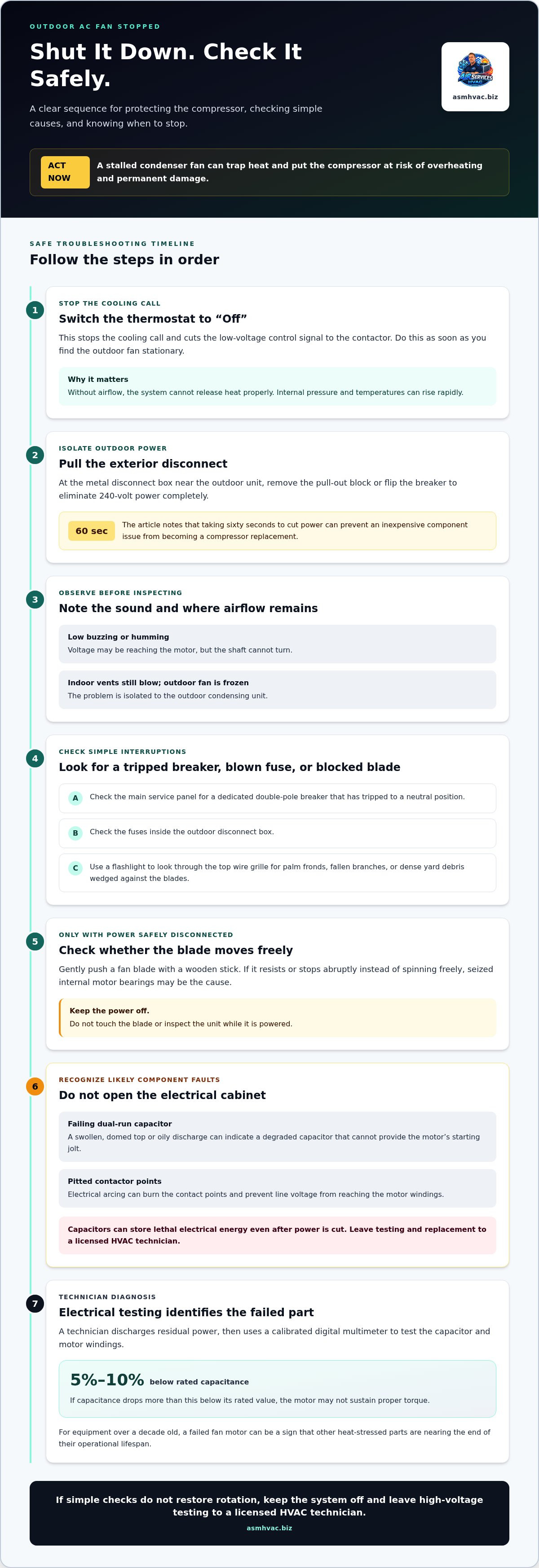
- Switch the thermostat to "Off": This stops the cooling call and kills low-voltage control signals to the contactor.
- Pull the exterior disconnect switch: Open the metal disconnect box mounted on the wall near the outdoor unit and remove the pull-out block or flip the breaker to eliminate 240-volt power completely.
Taking sixty seconds to cut power prevents an inexpensive component issue from turning into a total compressor replacement.
Diagnosing Common Causes Behind a Stalled Air Conditioner Fan
Finding an air conditioner fan not spinning does not always point to complete mechanical failure. Start your inspection with the simplest electrical links. Head to your main service panel to ensure the dedicated double-pole breaker hasn't tripped to a neutral position, then check the fuses inside your outdoor disconnect box. Next, look through the top wire grille with a flashlight. Palm fronds, fallen branches, or dense yard debris can easily wedge against the fan blades, physically stopping them from rotating.
Troubleshooting Bad Capacitors, Dead Contactors, and Seized Bearings
If the blades are clear and power is confirmed, the issue typically sits within the electrical components or motor housing:
- Seized Motor Bearings: With power safely disconnected, gently push a fan blade using a wooden stick. If it resists or stops abruptly instead of spinning freely, the internal bearings have locked up from excessive friction and dry lubrication.
- Failing Dual-Run Capacitor: Triple-digit Inland Empire summer heat is notorious for baking capacitor internals. A degraded capacitor often shows a swollen, domed top or oily discharge, leaving the fan motor without the electrical jolt needed to initiate rotation.
- Pitted Contactor Points: The outdoor contactor acts as a heavy-duty electrical switch. Over time, electrical arcing burns the contact points, preventing line voltage from flowing to the motor windings.
Never open the electrical cabinet to test or swap capacitors yourself. These cylindrical components store lethal amounts of electrical energy even after you cut the power. If simple visual checks don't restore rotation, scheduling reliable AC repair in Redlands ensures an expert tests the circuit safely.
Professional Repair Solutions and Restoring Safe Cooling in Redlands
Restoring a stalled condenser requires precise diagnostic equipment and strict electrical safety practices. When faced with an air conditioner fan not spinning, a technician begins by discharging residual power before taking readings with a calibrated digital multimeter. They measure the microfarads (µF) across the dual-run capacitor terminals; if the capacitance drops more than 5% to 10% below its rated value, the motor cannot sustain proper torque. The technician also measures winding resistance across common, start, and run leads to check for internal shorts before recommending any parts.
When dealing with equipment over a decade old, replacing a failed fan motor often signals that other heat-stressed parts are nearing the end of their operational lifespan. If simple breaker checks leave your air conditioner fan not spinning, reaching out for expert AC repair in Redlands CA gives you an honest assessment of whether a component replacement or broader system update makes the most financial sense.
Choosing Qualified Local Service and Long-Term System Protection
Inland Empire summers put brutal thermal strain on outdoor condensers. Certified technicians protect your investment by verifying running amp draw against OEM nameplate specifications under full summer load conditions, ensuring the replacement motor runs cool.
Enrolling in regular preventative HVAC maintenance services catches out-of-spec capacitors and weak contactor points during spring inspections before peak July heat waves cause sudden failures. For emergency breakdowns across Redlands, Yucaipa, and Highland, Air Services Mechanical provides 24/7 dispatch backed by over 20 years of local experience, NATE-certified technicians, and straightforward, upfront pricing.
Restore Safe, Reliable Home Comfort Today
Leaving an air conditioner fan not spinning risks turning a manageable electrical issue into severe compressor damage. Taking quick action to shut off the equipment at the thermostat protects your system while you check for obvious obstructions or tripped breakers. When the fix involves hazardous high-voltage capacitors or internal motor wiring, partnering with seasoned local professionals gives you complete peace of mind.
With over 20 years of trusted HVAC service across Redlands and the Inland Empire, our team is ready to help. Our NATE-certified and EPA-certified technicians are available 24/7, offering straightforward pricing with no long-term contracts required. Schedule reliable AC fan repair with Air Services Mechanical today and get your home cool, safe, and comfortable again.
Frequently Asked Questions
Can I run my air conditioner if the outdoor fan is not spinning?
No, you shouldn't run your system if the fan stops. Operating the unit without airflow traps superheated refrigerant inside the condenser coil, rapidly spiking internal pressures. This forces the compressor to overheat and trip its internal thermal overload switch. Repeated overheating cycles will scorch protective lubricating oil, causing permanent compressor burnout and leaving you facing major equipment replacement.
Why is my AC unit humming loudly but the fan blades are still?
A loud hum indicates that high-voltage electrical power is reaching the condensing unit, but the fan cannot turn. When you find your air conditioner fan not spinning while humming, the dual-run capacitor has likely lost the charge needed to kickstart rotation. Alternatively, the contactor could be sending voltage to a motor with seized bearings or debris wedged against the blade assembly.
How do I know if my AC fan motor or capacitor is bad?
Capacitors and motors display distinct symptoms during diagnosis. A failing capacitor often bulges at the top, leaks oily dielectric fluid, or reads outside its rated microfarad range on a digital multimeter. If the capacitor tests within normal electrical tolerances but the motor shaft resists turning freely or shows open winding resistance, the fan motor has failed mechanically or burned out internally.
Can I jumpstart my air conditioner fan with a stick?
Nudging a blade with an insulated wooden stick is an informative diagnostic clue, but it isn't a permanent solution. If your air conditioner fan not spinning suddenly begins turning after a gentle push, the run capacitor is failing and cannot provide startup torque. The fan will stall again during the next cooling cycle, leaving the compressor vulnerable to severe thermal strain.


